As we all know, the last of the cardinals arrived today in Rome to prepare for the conclave that will choose the next pope. These are undoubtedly very busy days for them as they gather for a world-affecting decision, so if I were someone on any cardinal’s immediate staff, I wouldn’t presume to call him unless it were something of a very urgent nature. Yet today, Cardinal Dolan took time out of his preparations for conclave to call me personally on my cell phone to see how I am doing after my rotator cuff surgery three weeks ago! He didn’t have his secretary call me in his name; he called me personally. Imagine how important that made me feel! Anyone would certainly understand if he could not keep in touch with us, and even when he is here in New York I hardly expect a phone call from him about a non-life-threatening surgery, but he has now contacted me not once but twice. And I don’t even know how he found out I had surgery!!!! I for one am extremely grateful for Cardinal Dolan and the fatherly love he gives us all. Some people have asked me, “So, do you think Cardinal Dolan will be elected pope?” My response is, “I hope not! I don’t want to lose him!” But if he is chosen and we must lose him, the Church Universal would be getting a true Holy Father! For now, may the Holy Spirit guide the College of Cardinals in their very important decisions!
Candy on Sundays of Lent Anyone?

Tomorrow Lent begins, and I can guarantee there is one question I will field frequently: are we permitted to have whatever we gave up for Lent on Sundays of Lent? I can’t give you an absolute “yes” or “no” answer. In ancient times it was permitted because Lenten fasts were severe: forty days of abstinence not only from meat but also from most other foods as well, so Sunday was a necessary break for physical survival. Today, our penances tend to be far less severe, so taking a break on Sunday is not necessary for our survival. There is no official church teaching on the matter, but there are two different schools of thought: one is that, since Sunday is a day of rejoicing in the resurrection of Christ, it makes no sense to do penance on a day of celebration; thus, you may eat your chocolate and drink your soda. The other is that, although it is Sunday, we still do not sing the Gloria or the Alleluia at Mass, nor do we adorn the altar with flowers, which are all normal parts of celebration, so we should observe our Lenten promises even on Sunday. We are each free to follow whichever opinion we accept, but I ask people this: if you are going to relax your penance on Sunday during Lent, is it because you are rejoicing in the resurrection of Christ, or are you looking for an excuse to eat what you gave up? If it’s truly for rejoicing, great! But if not, then we should continue or fast even on Sunday. My personal recommendation – and it’s only that – is that we continue our Lenten observance even on Sunday.
2012 in review
The WordPress.com stats helper monkeys prepared a 2012 annual report for this blog.

Here’s an excerpt:
600 people reached the top of Mt. Everest in 2012. This blog got about 2,000 views in 2012. If every person who reached the top of Mt. Everest viewed this blog, it would have taken 3 years to get that many views.
“Xmas”: Embrace it or X it out?
One of my personal pet peeves is the use of “Xmas” instead of “Christmas”. I’ve always complained that it is “crossing Christ right out of Christmas” and have argued that it should never be used. I have encountered many people who share my feelings about this. On the other hand, I have encountered people who disagree with me, sometimes adamantly, that there is nothing wrong with using Xmas, that the X is actually the Greek letter chi, the first letter in “Christ” in Greek, and that it was used in ancient times during persecutions by Christians to identify themselves to each other when they could not mention Christ publicly; therefore, it is a pious action to write “Xmas” which gives great honor to Christ. So which is true?
I guess we could never know for certain without asking Jesus Himself. I think, however, He would consider the intention behind its use. Certainly, during the days of persecution, He would have been well-pleased by this pious use of the Greek letter X to represent Him. But how about today? It seems to me it would depend upon why we are using the X. When someone writes “Xmas” today, is he using it because he is thinking of the ancient Christians and their struggle during persecution, and is uniting himself with them and honoring them by using their symbol as his own in prayerful worship of Christ? If anyone thinks he truly is, please contact me, as I have some swampland in Arizona for sale, really cheap! Come on, get serious. He’s not doing it to honor Christ, he’s doing it because it’s faster, and the explanation of the X as an ancient symbol for Christ is just an excuse he’s using to justify continuing to use Xmas. Furthermore, priests who use the “chi” argument to defend this practice are in my mind guilty of accommodation to secularism. Just that fact that people call it “Xmas” rather than “chi-mas” shows they don’t know a thing about the Greek alphabet and are not using it to honor Christ. The reason people are using it is simple: it takes less time to write an X than to write out “Christ”. Is not the Holy Name of the One who became man and endured the agony of the cross to save us from our sins worth taking the time to write out? Do you realize that Christmas is the only feast in the entire calendar that has the name of God in it, and it is the only feast whose name we feel the need to abbreviate? We write out “Valentine’s Day”, “Independence Day”, “Memorial Day”, “Thanksgiving Day”, yet with Christmas we resort to “Xmas”. Why are all these other days worthy of the time to write out longhand but the Holy Name of Christ is not? And if you think about it, “X” in mathematics is the unknown number, the answer we’re trying to figure out. So in writing “Xmas” we are perhaps prophetically declaring one of the biggest problems of Christmas: that lots of people have no clue what they are in fact celebrating. Perhaps it is for them a great feast of the unknown!
Yes, the Greek letter chi (X) was once used as a pious symbol for Christ, but symbols change their meaning over time, and what was once appropriate has now become a symbol of the secular “no-Jesus” Christmas. While some people would argue to preserve “Xmas”, I say we cease using it and take the time to write out “Christmas,” as the Holy Name is worth the time. In a world so determined at times to wipe Christ out of it, let’s make a concerted effort to put Christ back, and the more the world tries to mask Him, the more we will reveal Him. Let’s cease saying “Seasons Greetings”, “Happy Holidays”, and “Merry Xmas”, and start again using “Merry Christmas!” His Name is worth it!
Our freedom to worship
I’d like to ask you to visit the post on Matt Fradd’s blog about his recent trip to Saudi Arabia. Public worship by Christians is forbidden there, but there are Catholics who are worshipping in secret. Check out what he has to say at this site:
http://mattfradd.com/2012/11/28/persecution-in-the-middle-east/
“All My Pastor Ever Does Is Talk About Money!”
“I can’t stand my parish! All my pastor talks about is money!” I’m sure we’ve all heard plenty of people complain about that over Thanksgiving dinner, at little league games, wherever people gather and have time to chat. From time to time people ask me for advice as to what to say in response to people who say such things.
Well, first of all, let’s face brutal reality: there are some pastors who talk about money too much. It’s not that the parish is really in dire straits, it’s just that he doesn’t seem to know what else to talk about. Pity the pastor who has lost his vision of shepherding the flock and feels that, as long as his parish is financially in the black, everything is ok. It is not. However, the pastor is responsible for the temporal well-being of the parish, and if there isn’t enough money to pay the bills, he has to try to increase revenue. I don’t think any reasonable individual could fault him for that. The pastor has an obligation to keep the people abreast of the financial situation of the parish. Many people would say that they’d happily increase their offering if the pastor only asked for more. But it is also equally true that a lot of pastors are accused of only talking about money by people who just don’t want to hear about it. It is usually not from the people who are doing their best, but from those who know very well that they are not and are being made to feel guilty about their poor giving. You know the old saying, “When you throw a rock into a group of dogs, the one who barks is the one you hit!”
I have used this story to explain to my parishioners the way we all must view our giving:
Suppose you have a family project to do, such as clean out the garage. The mother and father tell their three children to make no other plans for this coming Saturday, because everyone will be needed. The three children are as follows; first is Joe, the oldest. Joe works like a workhorse, doing the bulk of the work, and never asks if he’s done “his share,” but always works until the job is done. Secondly, there is Mary. Normally, Mary would be like Joe, but Mary broke her leg and is in a cast. She cannot lift boxes, but she gladly agrees to do whatever she can, perhaps sitting at the workbench and cleaning it up. Then there’s Junior. Junior shows up with his cellphone in hand, and while everyone else is working, he’s texting away. Eventually, Joe and Mary start to complain to Dad that Junior isn’t working. Repeated attempts to get Junior to help are fruitless. Finally, Dad resorts to a threat: “Junior, either you start helping or you will not be allowed to have dinner tonight!” So Junior, while continuing to text with one hand, goes and picks up an empty paint can, puts it in the garbage pile outside and says, “There! I helped!” and then sits down again and continues texting. What would you want to do with Junior? Joe complains, and Dad asks him to pick up the slack for Junior because the work has to get done. Joe would never say no because he loves his father and realizes he needs his help. But he begins to hold animosity for Junior. Mary begins to feel bad that she can’t do more, and starts feeling guilty. And Junior just continues to text away! Tensions begin to mount. Is this an example of a happy, functional family?
When it comes to financial support of a parish, there are always parishioners like Joe. They have the means and give substantially, perhaps even more than is their fair share, but they do it and don’t complain because they love their parish and care about its success. These are the people that basically carry the parish financially. Whenever the pastor asks for money, they always give more. Then there are others like Mary. Their income may be limited, they may be unemployed, but whatever the cause, their finances are very tight and they are struggling to make ends meet. They give the best that they can and wish it could be more, and are usually the ones who say, “Father, if I only had a million dollars I’d give the parish half of it!” These are the people that I have to remind not to feel guilty, that like the widow’s mite, every sacrifice is appreciated by God, even if the amount is small. Finally, there’s the problem group: the Juniors. They are the ones whom you see driving nice cars and throwing a buck in the basket; if you’re lucky, a $5 bill! These are the ones the pastor is trying to remind to carry their weight. And you guessed it! The Juniors are the complainers, the ones who accuse the pastor of “only talking about money.” They sometimes threaten that they’re going to find another parish where the pastor doesn’t “forever talk about money.” Well, if they succeed, then what they’re really looking for is a parish where others are giving so well that they don’t have to worry about pulling their weight; in other words, they want to be freeloaders! So if someone should ever complain about their pastor “always talking about money” and you know it’s not true, tell them they’re looking for a free ride and are not taking seriously the responsibility that everyone has of proper stewardship, that is, doing our duty to take care of and preserve what has been given to us by God and by those who came before us, so that we will be handing on the same vibrant parish to our children that we got from our parents.
Should Catholics Celebrate Halloween?
This week of course we celebrate Halloween. You may have encountered people who try to tell us that Christians should not celebrate Halloween because it glorifies evil and witchcraft and teaches children to embrace them. Well, my response to this is simple: “Hockey Feathers!” What better way to show that we do not fear Satan than mocking him? Remember, “Halloween” is short for “All Hallows Eve”, the night before All Saints Day. I like to think of it as saying to evil forces, “Go ahead! Have your last hurrah, for tomorrow as we honor all the saints you will be tormented by your own decision to reject God!” 
Catholics, then, of all people should most definitely celebrate Halloween! There are a few warnings, however, that we must observe! One is to remember that All Saints Day is a Holyday of Obligation, so we must make sure we attend Mass on November 1st. Celebrating Halloween without celebrating All Saints Day misses the whole point! Secondly, – this is especially for the junior high crowd – damaging people and property is not an appropriate part of Halloween! Mock evil, don’t participate in it! Finally – and this is usually a caution we must remind adult revelers – make sure your costume is not insulting to any good people, is not of a filthy nature, and is appropriate for you to be wearing. Imagine down the line if your child should find a photo of you in your costume! How would you explain THAT?! So go out and trick or treat, have fun at a Halloween party, but keep it safe, keep it clean, keep it appropriate, and GO TO MASS FOR ALL SAINTS’ DAY!!!
5 fears about going to confession, and how to overcome them
Don’t get me wrong! I am not for a moment advocating excessive drinking and getting drunk! But sometimes when at a party, a wedding, or some other social event, someone with a few drinks under his belt starts to loosen up about deep, dark, secrets that he would never discuss when sober, and invariably I end asking him if he’d ever brought his concern into confession. Usually, there is a major balk at the idea, and the person will say, “Oh, I could never go to confession! I’d be too ashamed!” I then ask him “if you were very sick, would you be ashamed to go to the doctor?” They usually get the point.

Going to confession is like going to the doctor for your soul. But of course, some people have fears about confession that they would never have about going to a doctor. These fears, while perhaps understandable, keep people away from the healing touch of Christ. As a priest, I have the great advantage of knowing what it’s like to be on both sides of the screen. I need to go to confession like anyone else, but I also get to be the one hearing the confession and offering absolution. So permit me to discuss and dismiss several common fears people have about confession:
#1: “If I even attempted to walk into a church, the roof would fall in!”
Sorry! It’s never once been observed! Church roofs today are equipped with specially constructed spiritual beams that keep the plaster, shingles, and tiles all in place even if the worst of sinners should enter, and they come with a lifetime guarantee!
#2: “If I actually told my sins to a priest, my confession would cause him to have a massive heart attack!
Believe me! You don’t have to be ordained very long before you’ve heard everything! There is nothing you can say that is going to shock a priest. What took all of your strength to say is probably just another typical day hearing confessions for the priest. Don’t be afraid! We’ve heard it all!
#3: “It’s been so long I’ve forgotten how to go!”
If that’s the case, all you need to do is say to the priest, “Father, it’s been so long I don’t remember what to do nor do I even remember the Act of Contrition,” and the priest will take it from there. All you need is a desire to go!
#4: “I could never tell Father ‘So-and-So’ that! He knows me! What will he think of me?”
What he’ll think of you is that he is someone whom you trust completely with something very personal that he knew was hard for you to find the courage to talk about. He will not be ashamed of you. If anything, he will have greater love and respect for you because you are trying to change and overcome your sins. When I go to confession, I find it more powerful to sit face-to-face with a priest I know and lay it all on him. It actually feels wonderful knowing I have told my worst deep embarrassments to someone I know and that he understands and is encouraging me. If Father can be compassionate and forgiving, how much more does Jesus understand and forgive!
#5: “God would never forgive me THAT!”
Suppose Adolf Hitler, right after he shot himself, had a moment of regret and asked God to forgive him. Do you think God would forgive him? Of course! If Satan himself should ever turn to God and say, “Father, I’m sorry for rebelling against you, and I’m sorry for harming your creation all these years! Please forgive me!” Would God forgive him? We know the answer is “Yes”. So if God could forgive Adolf Hitler or Satan – with all the evil they did – do you think He will refuse to forgive you your sin, no matter how serious it is? Remember that God is trying to get us into Heaven, not to keep us out!
When the Lord Jesus was revealing the Divine Mercy to St. Faustina, the priest who was her confessor was having difficulty figuring out whether the apparitions she reported were real or fantasy, so as proof, he asked Faustina to ask Jesus to reveal to her what the priest’s last mortal sin was. When she asked Jesus “What was Father’s last mortal sin?” Jesus responded, “I don’t remember!” Jesus did not die on the cross to hold us forever accountable for our sins but rather to take them away and forget about them! So don’t be afraid to bring your sins to Jesus for forgiveness, no matter how serious they may be. He WILL forgive you!
“Okay, but what if I keep committing the same sin over and over?” Well, one thing a priest is never allowed to ask you is: “Will you promise me you will never commit that sin again?” He can’t ask that because you can’t promise that. All that you can promise is that you’ll try, even if in the back of your mind you know you may fall again.
“But does God ever get tired of forgiving us? Does He ever say we’ve exhausted our supply of forgiveness? Will He ever say, ‘Hey! you’ve confessed this over and over and nothing changes! It’s time to bite the bullet and stop?’”
We might think He should – but He doesn’t! I find sometimes when I go to confession that the priest should say that to me, but he never does. God always forgives me, over and over and over, even if I don’t think He should. God has patience with me when I’ve lost patience with myself. That only tells me that God loves me even more than I love myself! Sometimes the hardest forgiveness there is to receive is not God’s but our own. If we’re afraid to go to confession, maybe it’s because we don’t feel we deserve to be forgiven. Even if you don’t think you’re worth forgiving, God does! Don’t be afraid. He is longing to forgive you – He died to forgive you – let him!
You are Going to Rome!!!!!!
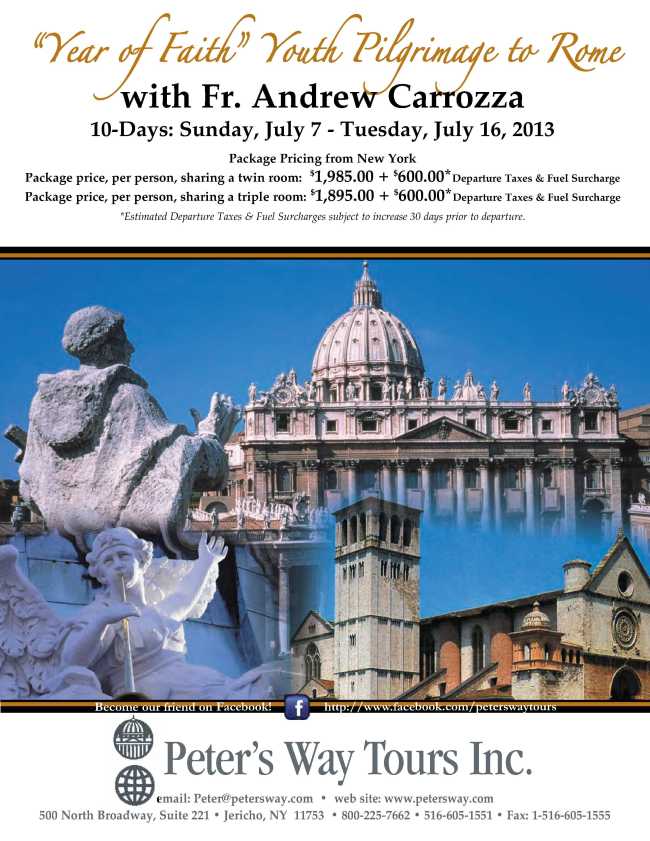
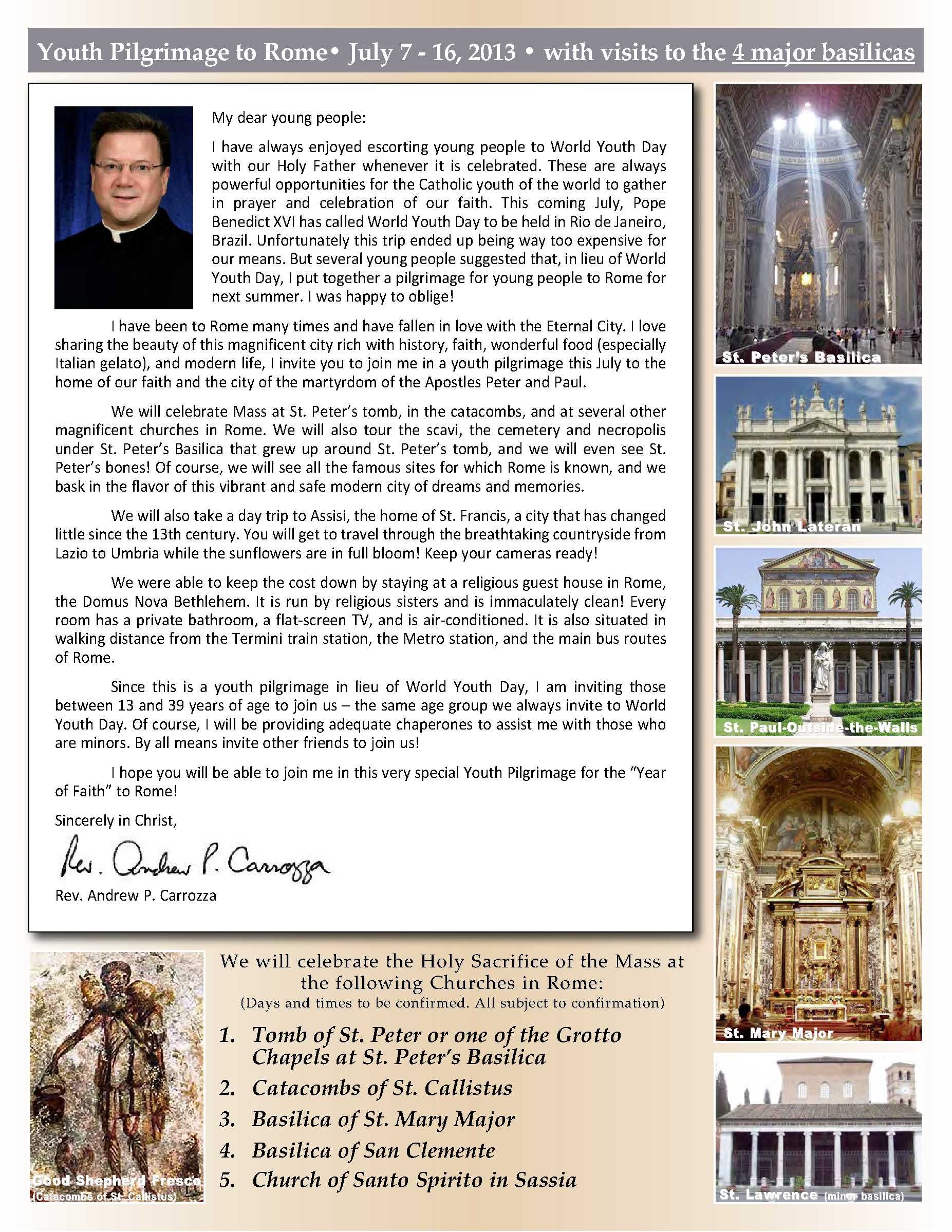
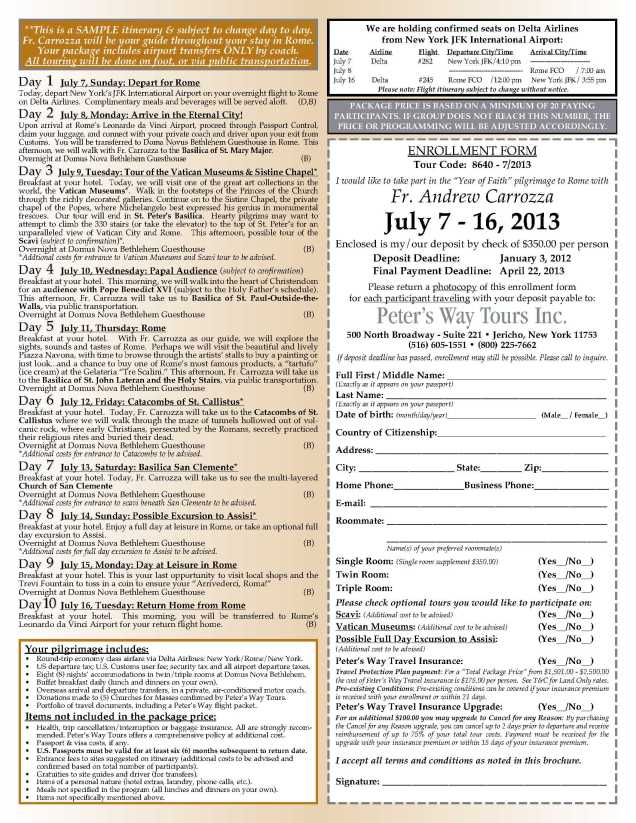
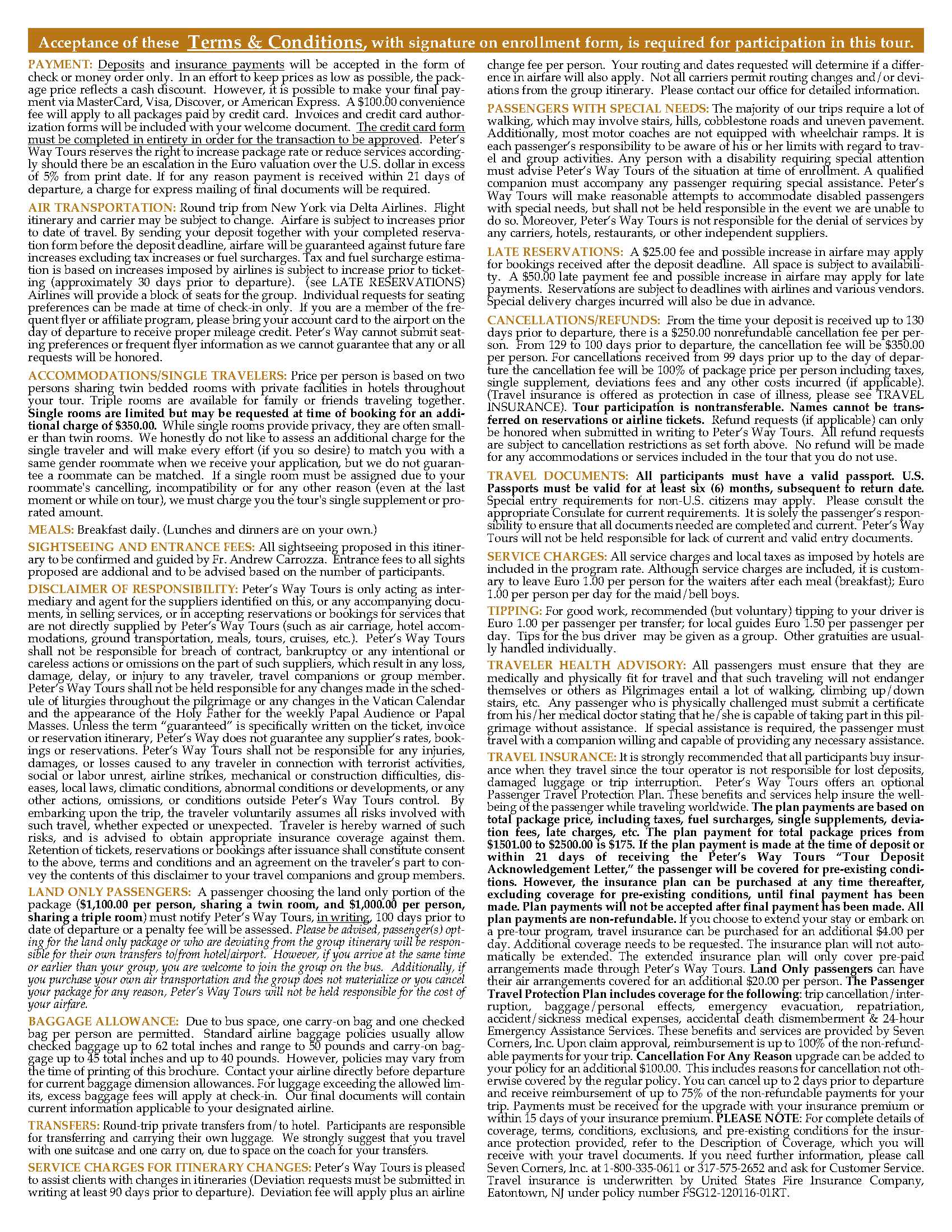
I am very pleased to announce that, at the suggestion of several young people I know, I will be leading a Pilgrimage for Youth to Rome this coming July. It will be open to anyone who is currently in 7th grade through those 39 years old. The flyer below gives all the information. If you’re interested in attending, simply sign up and send in your deposit. I hope you can join me in Rome!
Jesus the Wimp!
From time to time I enjoy reading comments people post related to internet news stories. Some are juvenile and insulting, but others are intelligent and well-written. Today a story appeared on MSN of yet another fragment of an ancient text that says that Jesus had a wife. Of course, many people immediately hauled out the worn-out canard that another proof that the Church is wrong has surfaced, and that the Church maliciously suppressed these documents because they showed a truth they didn’t want to acknowledge. Historians have always known that these documents existed, but they also have always known that they have no historical credibility. They were not written by people reporting what Jesus truly said and did. Rather, they were deliberately fabricated by groups such as the Gnostics in an attempt to make people believe the vision of Christianity that they desired to see but which Jesus did not in fact create. A married Jesus would suit their needs well, so they created it. The truth is that these documents were not delegated to the dustpans of history because they were ruthlessly suppressed, but because no one took them seriously, and they were simply abandoned as worthless.
But that’s not the point of this post. Instead, I wish to comment on what some people wrote in defense of the faith. Numerous people, in a valiant attempt to defend the veracity of the Church, pointed out that the heart of the Gospel is not whether or not Jesus married but his call to love one another. There were numerous posts of this nature: “God just wants us to love one another”, “Love God and love your neighbor”, “Be kind to one another”, etc. All of this is and true and good. But it is not the summation of the Gospel, and therein is where I think we have been weak in defending the faith and perhaps why it is not as popular is it should be.
I frequently receive responses from people stating that “Jesus understands” and “God just wants me to be happy.” The implication is that if Jesus loves us he’ll never allow us to be uncomfortable or suffer. Even parishes often avoid anything uncomfortable, and some priests have restricted their preaching to what I call “marshmallow theology” – soft, sweet, and fluffy, but containing no nutritional value. They limit themselves to preaching a sort of self-help psycho-spirituality, where you simply remember that God loves you and that you are special, so give yourself a big hug from God and remember how much he loves you! Well that’s nice and that’s true, but that’s Barney! Somehow I think the second person of the Blessed Trinity took on our human nature and died on the cross to teach us a little more than we can learn from a purple dinosaur! Some people even go so far as to think that Jesus doesn’t care about sin but only about how much we love him. I think Jesus cares about sin very much – enough to die on the cross to save us from it. Yes, God is all loving, all-compassionate, and all-forgiving. But there is more to God than that, and we frequently forget that side of him and have thereby presented the world with “Jesus the wimp!”
Any high school student playing a sport knows a good coach presses him to be the best he can be. At the time, the kid may not like it very much and may even curse out his coach. But when he wins a tournament or a medal, he is grateful that the coach pushed him even when he felt like he was at his limit, for he knows it was the coach’s belief in his potential and his constantly challenging him to be all he could be that made him succeed. Well, God is no different! Jesus loves us unconditionally and wants us to overcome sin and be strong against the devil. Yes, he tells us how much he loves us, but precisely because he loves us, he is not going to allow us to make excuses as to why we can’t do what he teaches us. He tells us the road will be rocky, but he will help us walk it. I specifically remember debating a young man who was gay who was trying to convince me that Jesus understood his plight and would allow him to have a homosexual relationship. He asked me, “What do you think Jesus would say to someone who told him he was gay?” His assumption was that Jesus would say, “I understand. Go out and love another man.” Instead, I told him I know exactly what Jesus would tell him, “Deny yourself, take up your cross and follow me!” Jesus is not a wimp, and the Gospel is not for wimps. To follow the Lord is a real challenge. Sometimes we forget to challenge people to be better than what the world says they can be. Maybe the fact that we have not presented people with the challenge but with a wimpy Jesus is a big part of the reason people don’t come to church any more. Who wants to worship a wimp?
Yes, following the Lord can be hard at times. If people have fallen into a deep pit, and one is able to climb out, what does he do for the others? He tells them that, yes the walls are steep and the climb will be difficult, but that is the only way to get out of the pit. He encourages them every step of the way to follow in his footsteps, as that is the only way to salvation. He doesn’t just sit on the rim and tell them to hold hands and sing Kumbaya!


