Question: How do you get your teen club to release all its pent up energy before the meeting begins so you’ll have their undivided attention?
Answer: indoor snowball fight!

Question: How do you get your teen club to release all its pent up energy before the meeting begins so you’ll have their undivided attention?
Answer: indoor snowball fight!
I’ve decided it’s time to wage war! Against whom, you ask? Against those inconsiderate people who chew very potent smelly gum in close spaces.
Have you ever been stuck next to someone on a plane who is chewing one of those horribly overly-scented mint gums that makes you want to puke? That happened to me recently. On top of this, she kept snapping it and exposing it on her tongue for everyone to see. Yesterday I was in a restaurant and the person at the next table was chewing a foul-smelling gum that clashed with the beautiful aroma of my dinner. Imagine! It was so powerful that I could smell it at the next table!! (I can only imagine what it did to her food!!!) You come across such obnoxious smells in elevators, subways, in doctor’s offices, in fact, it seems everywhere. I have no desire to become the gum-gestapo, but if I end up getting sick and spewing my breakfast all over them, I’m going to tell them it’s their own fault! I hope they like the smell of my breakfast a few hours later!
I know people have a right to chew gum, but I wish they’d be a little more considerate of those around them who may not appreciate being hit by a hurricane of stinky gum odor.

I’ve also never understood how women especially find snapping gum and swirling it on their exposed tongue to be glamorous. I don’t think I’ve never heard a man declare he was so turned on by the smell of a woman’s gum, or by the way she could snap it at such a high frequency pitch or manipulate it with her tongue. Reality check ladies! Chewing gum is NOT glamorous!!!
Please chew responsibly!
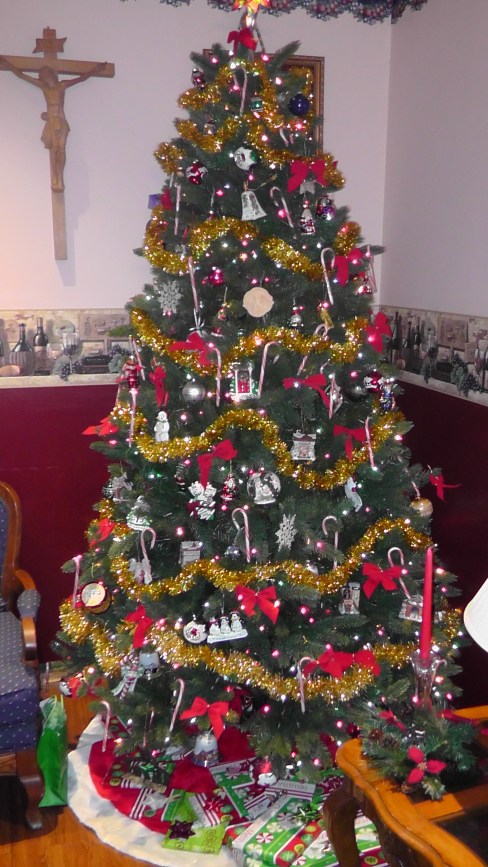
Christmas may be ending tomorrow, but here’s a video presentation of St. Ann’s Church at Christmas 2015. I am grateful for the help of Eric Czerniowski of Premier Landscaping, the 8th graders, and the student workers at St. Ann’s for their assistance in making our display so prayerful and attractive.

I have been reading a book by Fr. James Mallon entitled: Divine Renovation: From a Maintenance to a Missional Parish. While reading one chapter in particular I found myself shouting out, “Halleluiah!” At last I’ve found someone else who agrees with me and sees what I have been complaining about going on in churches every Sunday. I’ve reproduced the one segment here. The entire book is worth reading.
Giving Priority to the Weekend:
This is the day that the Lord has made; let us rejoice and be glad in it. (Psalm 118: 24)
Over the years I have been accused several times of turning the celebration of Mass into a production. As often happens in such moments, what I could have said came to me later – responses that would have been amusing, if not necessarily charitable. To the accusation that everything is a production, I am tempted to say, “Thank you, I’m so glad you noticed.” Duh!
Eleven years ago, after being a priest for six years and a pastor for three years, the obvious occurred to me. The only time we see 80% of our people is on the weekend, yet only 20% of my time in any given week was invested in planning, preparing and executing weekend Masses. It is the classic 80/ 20 rule. In pastoral ministry, it is easy to expend the other 80% of time and resources on a small number of people. I remember thinking that if the Church was a business, it probably would have gone out of business a long time ago with this kind of strategy. The Church is, of course, not a mere business, it is mystery, but grace still builds on nature and there is an essential truth here. The priority of any parish, and any priest, ought to be about preparing for and celebrating the Sunday Eucharist to make it the best possible experience for the maximum number of people. Too often in my own ministry, and in many parishes, the weekend, and everything that happens, had merely been an afterthought, a mild interruption to the real work of ministry that takes place from Monday to Friday. Sunday Eucharist ought to be a “production” in the best sense of the word. It deserves to be so. I presume here, of course, a positive connotation to “production.” We are not speaking of showmanship, or anything shallow and insincere. We are speaking about being intentional about every aspect of the Sunday celebration. To give our best for the Lord so that people who come to our church can leave with a sense of “Wow!” Why not? If I can go to a sports event or a concert and say “wow,” why shouldn’t this utterance be genuinely on the lips of those who have been sent from Church to “glorify the Lord with their lives”? The days of the 50-minute get-it-over-and-done-with Mass must end. Jesus told us that the Kingdom of God was like a wedding banquet. (Matthew 22: 1-14) The Eucharist is to be a foretaste of this banquet, and so it ought to produce an exclamation of “Wow!” It ought to be “a production.” Many of the values and examples that follow in this chapter do refer to the experience of Sunday morning, so I will refrain from giving any detail here. I do wish to say, however, that if the weekend celebrations are to be a priority, then we must have sufficient time on Sunday mornings to gather, celebrate and connect afterwards. This can be a real pressure on priests as we see the quality of Sunday mornings compromised because of our tight Mass schedules. The parking lot must be emptied on the hour so that those coming for the next Mass can arrive, or the priest must sprint for his car and play loosely with the speed limit to get to the next location for the next Mass. We need to honestly look at our Mass schedules, and ask what we truly value. Do we value meaningful and transformative celebrations of the Eucharist, or is our primary value convenient and static Mass times? Are we willing to change our Mass times so we can have more breathing space during and after each Sunday Mass? In some pastoral situations, due to the size of the building, this may not be an option, but then there is another question: do we value our buildings over a meaningful and transformative experience of Sunday Eucharist? Saint Paul says in his Letter to the Ephesians, “There is one Lord, one faith, one baptism.” (Ephesians 4: 5) I sometimes think that the typical Catholic version of this scripture would read, “There is one Lord, one faith, one hour.”
In all my years studying Scripture, theology, the history of the Church, and canon law, I have not found any reference to Sunday celebrations having to be no more than one hour “or else.” Furthermore, in all the times I have crossed over (God forbid) the one-hour mark, I have never seen a single person turn into a pumpkin. Never! Where does this value come from? Sports events are never less than an hour. If we went to a concert that was only an hour long, we would demand our money back. Movies and theatre productions are usually about two hours long, but “Thou shalt not go over one hour for Mass!” Where Did That Come From? During my first year of ordination, I was assigned as an assistant priest at the Cathedral. Every other weekend, I found myself filling in around the diocese. I enjoyed this very much, as I was able to get to know the lay of the land. I will never forget my first experience of Palm Sunday as a priest. I was sent on Saturday afternoon to fill in at a local city parish. I was so excited about my first Palm Sunday celebration: a procession of palms, singing, the reading of the Passion and a chance to invite the people to enter into the riches of the Sacred Triduum in the days to follow. I arrived at the church and was met by a very grumpy usher who told me in no uncertain terms that there would be no procession and that there would be no homily. When I asked him why, he told me that people “were on medication.” By the time that liturgy was over, I needed to be on medication! I was the only person in the whole church, other than the cantor, singing Hosannas during the entrance, and in spite of the glares of the usher and his companions, I did dare to preach, even if only for five minutes. So much for my first Palm Sunday celebration, which did conclude, by the way, within the one-hour mark. My friends from Africa tell me that in their countries, people bring their lunch to Mass, and their celebrations can last well beyond the three-hour mark. I have been to Masses in the Vatican that regularly go beyond two hours. When Eastern rite Christians, Catholic and Orthodox, celebrate Divine Liturgy, it would be unspeakable to even try to bring it to completion before the 90-minute mark. Evangelical and Pentecostal Christians will sing for an hour, and you know that the pastor is not going to preach for any less than half an hour. So why are we so different as Catholics in North America and in Europe? The answer is so simple: habit. We formed the habit of fast-track Masses due to constrictions of pastoral practice at a time when our churches were full and it was a societal value to go to church. In 1950s North America, it was not uncommon to find urban parishes that had eight or nine Masses on a Sunday morning. These Masses would be on the hour from 6: 00 a.m. until noon, often with two different celebrations at once – one in the church and one in the basement. Parishes had to schedule in this manner for two reasons: 1) the sheer number of people who came to Mass, and 2) the discipline of fasting at that time. Before the Second Vatican Council, Catholics receiving the Holy Eucharist were required to fast from food and water from midnight the night before until they received the Eucharist. This explained the prevalence of early morning Mass, after which the faithful could break their fast at “break-fast.” It also explains why Masses did not usually go later than noon. Senior priests who remember those days have told me stories of how fainting and collapsing parishioners were a common occurrence. Today, we have vigil Masses on Saturday evening as well as Sunday evening Masses. The Eucharistic fast is only one hour before receiving Holy Communion, and we do not have the sheer numbers of people attending Sunday Eucharist as we did in the past. The context that conditioned Catholics in the Western world to get addicted to the 45-minute Mass no longer exists, but the practice lingers on. In the end, it is not really a question of how long the Mass ought to be or could be, but whether this value leads us to health. I believe it does not. It contributes to a “get it over and done with” mentality that turns our Eucharistic celebrations into something to be endured rather than something that endures. Serving the unspoken value of “convenience” may be the reason why, in spite of the change in context, we continue to value the one-hour Mass. I remember as a young teenager going to a Saturday afternoon Mass in town with a friend of mine. This Mass was held in a retirement home and was a Sunday Mass. Presumably, the residents of that home did need food and medication, and somehow the priest was able to move through the entire Sunday liturgy from beginning to end, including a brief homily, in 20 minutes (after being a priest for seventeen years, I still have no idea how he did this). The point of this story is not the amazing feat of rapid worship, but the fact that there were at least a hundred non-residents of all ages who crowded into the small common room and lined the hallways outside in order to avail themselves of the fastest Mass in the West. I cannot be too indignant on this matter as my best friend and I were there for exactly the same reason.
A Culture of Minimalism:
The fast-Mass addiction continues to be played out in parish after parish all over the Western world. During my first months at Saint Benedict, I had to address what I considered to be a major problem at our Saturday vigil Mass. We used to get about 600 people at this Mass, and at least 25% of them would leave as soon as they had received the Eucharist. That was bad enough, but the back wall of our church is all glass, and you can see the entire foyer from the front of the church. I will never forget the first time I saw this: I could not believe my eyes. Hundreds of people were leaving while I was still giving out Holy Communion. Over the weeks that followed, I addressed this phenomenon in the parish newsletter and during Mass. I was bold enough to say that, although there were indeed exceptional reasons to leave Mass directly after receiving communion, anyone who left at that time every week needed to seriously consider what they were doing. I suggested that they refrain either from leaving early each week or from receiving the Eucharist. This earned me a stream of anonymous letters, including a letter to the bishop and even a letter to the pope (a first). Some of these letters informed me that if Mass was not so long, then people would not feel compelled to leave early. Two weeks later, the priest who was assisting at the parish was presiding at the Saturday Mass. I was planning to make a few announcements at the end of Mass. I pulled into the parking lot at 4: 45 p.m. (45 minutes into Mass) only to see the usual flood of people heading for their cars. That’s why I am convinced that this phenomenon has little to do with the length of Mass and more with a desire to just get it over and done with. The sad truth is that we as pastors have often catered to this minimalist culture, but what other option did we have when we were working within a model of pastoral care that required the feeding of people who had no appetite? Remember that we come from a tradition that would discuss this question: How much of the Mass can I miss and still have it count? A commitment to the priority of the weekend means declaring this frustrating capitulation to be over. Minimalism and convenience cannot be the primary values of a healthy church. Minimalism and convenience have no place in the life of the disciple who is called to save his or her life by losing it. Someone once said that Jesus doesn’t ask for much – he asks for everything. If our liturgies are to be meaningful and transformative “productions,” they need to be able to breathe and not be constrained by a rigid one-hour rule.
Likewise, there needs to be enough time between Masses so that those who are hungry for God are able to linger with one another after Mass to encourage and support one another. We as pastors are called to facilitate this, even if it means – horror of horrors – changing Mass times, eliminating under-attended Masses, or even acknowledging that we are being confined by buildings that no longer serve the needs of this new pastoral context.
Mallon, Fr. James (2014-09-01). Divine Renovation: From a Maintenance to a Missional Parish (Kindle Locations 1417-1421). Novalis. Kindle Edition.
When the Supreme Court legalized marriage in all 50 states of the union this past summer I knew it would be inevitable that people would be asking whether or not they could attend the marriage of a same-sex couple. May we attend or should we politely bow out? Before we answer, let’s set a foundation.
By attending an event we implicitly show that we are giving approval to the event. Imagine, for example, if we were to show up at a celebration by the Ku Klux Klan. There would be no way we can claim that we were just showing up for the event but not approving of the Klan. Similarly, how could we show up for a marriage celebration that violates what we believe without giving tacit approval to the event? As a rule, therefore, those who oppose gay marriage should not attend a same-sex celebration. Naturally, there will be an awkwardness involved in turning down the invitation. Sometimes someone may feel that they are so close to someone, especially an immediate family member or very dear friends, that they feel it would harm the relationship by not attending. If that is the case, the only way we could attend without implicitly approving would be to clearly let the individuals know beforehand that our presence should in no way be interpreted as approving of what they are doing. I know th at many people will find that a difficult thing to do, but sometimes in life we must do things that are awkward or difficult in order to remain faithful to our beliefs. Others may feel that they are judging the individuals by not showing up; in fact, that is precisely what the gay-rights community has been doing to us: making us believe that we are judging them by not approving of their activities. Nothing of that sort is taking place at all. Do not let individuals put you on the defensive and make it sound like you’re judging them. Actually, there is a breach of charity on their part if they should do that. Charity dictates that we should never deliberately place anyone in a situation where their presence would violate their beliefs, religious or otherwise. Would you invite an animal rights activist to attend the opening of a new fur salon and expect them to attend and be supportive? That would be uncharitable. Similarly, same-sex couples should not invite to their wedding someone they know does not approve of gay marriage. To do so would be insensitive on their part. Same-sex couples may have won the legal right to marry, but they must understand that not everyone approves of what they’re doing and for them to put anyone in a situation whereby they would be forcing them to choose between their relationship with them and their religious beliefs is unconscionable. I find that the onus is on a same- sex couple to be sensitive to other peoples’ feelings and not put them on the spot. If they worry that someone would be offended by not being invited, I would suggest adding a note with the invitation that says, “You are a very important person in my life and so I welcome you to take part in my celebration; however, I realize that this may cause awkwardness for you, and if you feel you cannot in good conscience attend I will understand.” Similarly, it would behoove a same-sex couple to understand if someone says, “listen, you’re very important to me and I love you but you know what you’re doing violates my religious beliefs and I cannot in good conscience celebrate with you.” If they are people of integrity, they will understand. If not, they are merely trying to use their marriage as a means to force you to accept their beliefs, even at the risk of violating your own, and that is wrong of them. They should not turn their celebration into a moral battleground. Let them celebrate with those who support them and understand that some cannot. So if you are invited to a same-sex ceremony, very politely inform the person that you cannot attend because it violates your religious beliefs and you’re sure they understand that and know you mean them no ill will. If you feel you absolutely must attend the event, make it clear to the person beforehand that under no circumstances should they interpret your attendance as approval of what they are doing.
One of the people who follow my blog asked me if I would write a column about what it was like behind the scenes while covering the Pope’s visit to New York. I’m happy to oblige him.
The Friday morning session covering the Pope’s address to the United Nations General Assembly was the tough one, as we had to be outsi de the United Nations at 3:30 AM. I had been at the Cathedral the night before for Vespers with the Pope and didn’t get home till almost 10:00 PM, so I was a little on the tired side. We made our way to the press pod, which was simply a fenced off area of United Nations Plaza in which each news crew was given an area designated merely by a piece of paper on the fence. We all had to have credentials and wear them through the police checkpoint. Once we were inside, it was all makeshift work. The crew had been there earlier to set up our space and the cameras. We sat in folding beach chairs while off camera and munched on whatever snacks we had brought. The fun part was finding a bathroom to use. There were no port-a-potties, and eventually found a residential building that graciously allowed us to use their basement facilities: we were there until 1:30 PM. I at least had a lot of time to sit and even catch a few winks, but poor Mary Calvi had to stand in front of the camera almost the whole morning!
Mary gave me a heads up as to what topic she wanted to discuss in the next segment, so I was never totally caught off guard. We were being fed information constantly from the studio via Mary’s ipad, and we discussed when we would talk about each topic and who would say what. She also asked me to add any information I knew as a priest that could add to the discussion at that point, which we did smoothly. They liked when I threw in a little comic relief, such as when I said it was too bad the Pope came all the way to New York and couldn’t take in a Broadway show! I did NOT mention – although the thought did cross my mind – of what would have happened if he did and the controversial topless ladies tried to pose for a picture with him! (You have to exercise quick discretion when you are on live TV!) I’d worked with Mary Calvi before and we’ve developed a nice style together. But this was the first time we were live!

The CBS crew
Thankfully, the weather was warm and balmy. We were treated to a beautiful sunrise over the East River and a beautiful sunny day. This was the first time I had ever used the earpiece with the studio giving us info in our ears, even as we are talking. You really needed to be a multi-tasker and be able to continue what you are saying while someone is sending you messages in your ear. The messages varied from when they’d be getting back to us through when to end discussion. I got caught off guard only once: we had a TV in front of us so we could see what was being broadcast at the time. Of course, you can’t see it while you’re looking directly into the camera, and at one point I thought we were off camera and looked down at the screen, only to discover to my horror that I was still on and was now looking at the ground on live TV! Uggh! The only time I almost got thrown was when a woman from the crowd walked up to the fence behind me while I was talking on TV and started asking the reporter in the next row in a very loud voice where the bathroom was! I felt like stopping and yelling, “Hey! I’m working here!” Fortunately, I didn’t, as I don’t think the studio would have been pleased. There was a lot of down time when we weren’t on, and I got to know the crew very well. We became instant friends, and although I was exhausted by the end, I felt sad that I was saying goodbye to them, as they were such great people!

with Mary Calvi
The Saturday morning segment at the studio was standard office work: people were checking over schedules and text for the segment. I didn’t get a full view of what everybody did and how it made its way to the script for the anchors, but what I saw was a friendly office-like process humming along. On the set, most was about the logistics of how high my chair was and whether I was too close or too far away from Mary Calvi. Fortunately, during the stretches where I was not on the air I was able to leave the table and take a bathroom break. I did get one personal delight, though. Before I studied for the priesthood I studied meteorology to be a TV weatherman. I was able to stand at the weatherman’s post and pretend I was giving a forecast. Of course it was all off camera and during commercial break so that it never interfered with the production, but it was still a fulfilling moment. When I was finally finished and told I could go home,
it was so anti-climactic. There had been so much work building up to the Pope’s visit, and I made several new friends, but they still had to continue their work, and we could only get a quick goodbye. I did get official feedback from CBS afterwards saying that the response from viewers was overwhelming and positive, and they asked if I’d be willing to come back for future events. Of course I said yes!
After all was said and done, I enjoyed the experience greatly, but I was never so happy to get back to my parish and do the work that is my real vocation!
There has been much discussion on many different blogs, in different newspapers, and in various areas of the media over the Synod on the Family which is currently going on in Rome. Many people are hearing that one bishop said this or another bishop said that and beginning to panic and start already building their defenses in order to fight back. I would caution people against any premature hysteria. I think one of the dangers going on here is the readily available media coverage of the synod without any filter of understanding. It should come as no surprise to anyone that there are bishops in the Church with varying opinions. It has always been this way; in fact, in the earliest centuries, the differences of opinion were sometimes so strong that they were met with fists, sticks, insults, and even banishment from their dioceses on some occasions. No society, no matter how holy, if it is made up of human members will ever avoid it. Those who somehow expect that all the bishops would get together with the Holy Father and that there would be not a single difference of opinion are living in a dream world. If that were the case, there would be no need for synod in the first place! What is critical is not what one bishop or another says, what one or another letter written to the Holy Father says, but ultimately the final decision by the Holy Father after the bishops have consulted with him. That is the only document that need concern us. In order for the Holy Father to be able to arrive at a good pastoral decision he has to be able to hear frankly and candidly from the bishops, as Cardinal Dolan told us he asked them to do and he and others who signed a letter to him before the synod began in fact did. To suggest otherwise would mean we’re expecting that the bishops would already come into the synod and simply say what the Holy Father wants to hear. Such a meeting would be useless. Therefore it is essential that bishops be able to state their opinions, even if they disagree radically with the opinions of others. There’s no way we can arrive at the fullness of truth about any issue without hearing from all the different nuances of the issue, even those who disagree with a belief or are against certain way of implementing those beliefs. So the day by day coverage of the media of everything that was said in trying to get leaked documents is counterproductive, as it leads people to think that because there is a bishop with an opinion that differs from that of another the church is somehow split asunder. Difference of opinion does not constitute dissent. Dissent would come into play if, after the Holy Father issues whatever decree he does from the synod there were several bishops who refuse to go along with it; that would be dissent. There is no indication at this point that any of the bishops are threatening dissent if the Holy Father doesn’t agree with them. So do not worry if you’re reading all the different stories that are being passed on about the synod. First of all, the reporters are not inside covering what was said, they are receiving materials handed to them sometimes secondhand. Also, many of the media that are reporting on the issues are not sufficiently trained to understand what it is that is in fact being discussed. My advice to everyone is to wait for the Pope to give the final document. That is the only thing that would have any authority over us and in any way representing any official teaching from the church.
Many years ago I counseled a young man who told me he had thrown himself headlong into the gay lifestyle, but eventually found it lacking and that it failed to provide the peace he though he would receive. I always knew there had to be others out there like him. Finally today, I came across a blog by someone who said the same thing. He gives a powerful defense of why the gay lifestyle failed him and how the Church is not wrong in not condoning homosexual activity. I encourage everyone to take the time to read his account, as it is a story that is almost never heard and is a refreshing new angle on what has become a worn-out discussion.
Having worked with young people throughout my ministry as a priest, I have discovered that youth spirituality is greatly underestimated. While yes, there are many teenagers that fit the stereotype of being rebellious people only interested in sports, sex, and drugs, that is certainly not true of many of them. Many teenagers are keenly aware of the real issues facing the world today, and some are not afraid of being heard. Witness, for example, the youth flash mob that took on a pro-abortion rally in defense of Planned Parenthood in Chicago. The Church is in good hands with young people like this! Way to go teens!

