5 fears about going to confession, and how to overcome them

Don’t get me wrong! I am not for a moment advocating excessive drinking and getting drunk! But sometimes when at a party, a wedding, or some other social event, someone with a few drinks under his belt starts to loosen up about deep, dark, secrets that he would never discuss when sober, and invariably I end asking him if he’d ever brought his concern into confession. Usually, there is a major balk at the idea, and the person will say, “Oh, I could never go to confession! I’d be too ashamed!” I then ask him “if you were very sick, would you be ashamed to go to the doctor?” They usually get the point.

Going to confession is like going to the doctor for your soul. But of course, some people have fears about confession that they would never have about going to a doctor. These fears, while perhaps understandable, keep people away from the healing touch of Christ. As a priest, I have the great advantage of knowing what it’s like to be on both sides of the screen. I need to go to confession like anyone else, but I also get to be the one hearing the confession and offering absolution. So permit me to discuss and dismiss several common fears people have about confession:

#1: “If I even attempted to walk into a church, the roof would fall in!”

Sorry! It’s never once been observed! Church roofs today are equipped with specially constructed spiritual beams that keep the plaster, shingles, and tiles all in place even if the worst of sinners should enter, and they come with a lifetime guarantee!

#2: “If I actually told my sins to a priest, my confession would cause him to have a massive heart attack!

Believe me! You don’t have to be ordained very long before you’ve heard everything! There is nothing you can say that is going to shock a priest. What took all of your strength to say is probably just another typical day hearing confessions for the priest. Don’t be afraid! We’ve heard it all!

#3: “It’s been so long I’ve forgotten how to go!”

If that’s the case, all you need to do is say to the priest, “Father, it’s been so long I don’t remember what to do nor do I even remember the Act of Contrition,”  and the priest will take it from there. All you need is a desire to go!

#4: “I could never tell Father ‘So-and-So’ that! He knows me! What will he think of me?”

What he’ll think of you is that he is someone whom you trust completely with something very personal that he knew was hard for you to find the courage to talk about. He will not be ashamed of you. If anything, he will have greater love and respect for you because you are trying to change and overcome your sins. When I go to confession, I find it more powerful to sit face-to-face with a priest I know and lay it all on him. It actually feels wonderful knowing I have told my worst deep embarrassments to someone I know and that he understands and is encouraging me. If Father can be compassionate and forgiving, how much more does Jesus understand and forgive!

#5: “God would never forgive me THAT!”

Suppose Adolf Hitler, right after he shot himself, had a moment of regret and asked God to forgive him. Do you think God would forgive him? Of course! If Satan himself should ever turn to God and say, “Father, I’m sorry for rebelling against you, and I’m sorry for harming your creation all these years! Please forgive me!” Would God forgive him? We know the answer is “Yes”. So if God could forgive Adolf Hitler or Satan – with all the evil they did – do you think He will refuse to forgive you your sin, no matter how serious it is? Remember that God is trying to get us into Heaven, not to keep us out!

When the Lord Jesus was revealing the Divine Mercy to St. Faustina, the priest who was her confessor was having difficulty figuring out whether the apparitions she reported were real or fantasy, so as proof, he asked Faustina to ask Jesus to reveal to her what the priest’s last mortal sin was. When she asked Jesus “What was Father’s last mortal sin?” Jesus responded, “I don’t remember!” Jesus did not die on the cross to hold us forever accountable for our sins but rather to take them away and forget about them! So don’t be afraid to bring your sins to Jesus for forgiveness, no matter how serious they may be. He WILL forgive you!

“Okay, but what if I keep committing the same sin over and over?” Well, one thing a priest is never allowed to ask you is: “Will you promise me you will never commit that sin again?” He can’t ask that because you can’t promise that. All that you can promise is that you’ll try, even if in the back of your mind you know you may fall again.

“But does God ever get tired of forgiving us? Does He ever say we’ve exhausted our supply of forgiveness? Will He ever say, ‘Hey! you’ve confessed this over and over and nothing changes! It’s time to bite the bullet and stop?’”

We might think He should – but He doesn’t! I find sometimes when I go to confession that the priest should say that to me, but he never does. God always forgives me, over and over and over, even if I don’t think He should. God has patience with me when I’ve lost patience with myself. That only tells me that God loves me even more than I love myself! Sometimes the hardest forgiveness there is to receive is not God’s but our own. If we’re afraid to go to confession, maybe it’s because we don’t feel we deserve to be forgiven. Even if you don’t think you’re worth forgiving, God does! Don’t be afraid. He is longing to forgive you – He died to forgive you – let him!
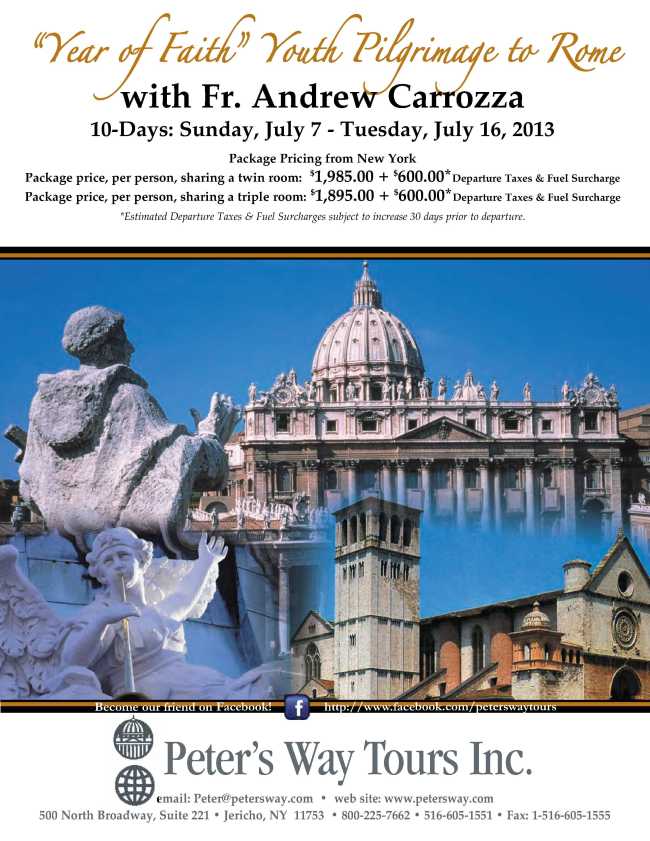
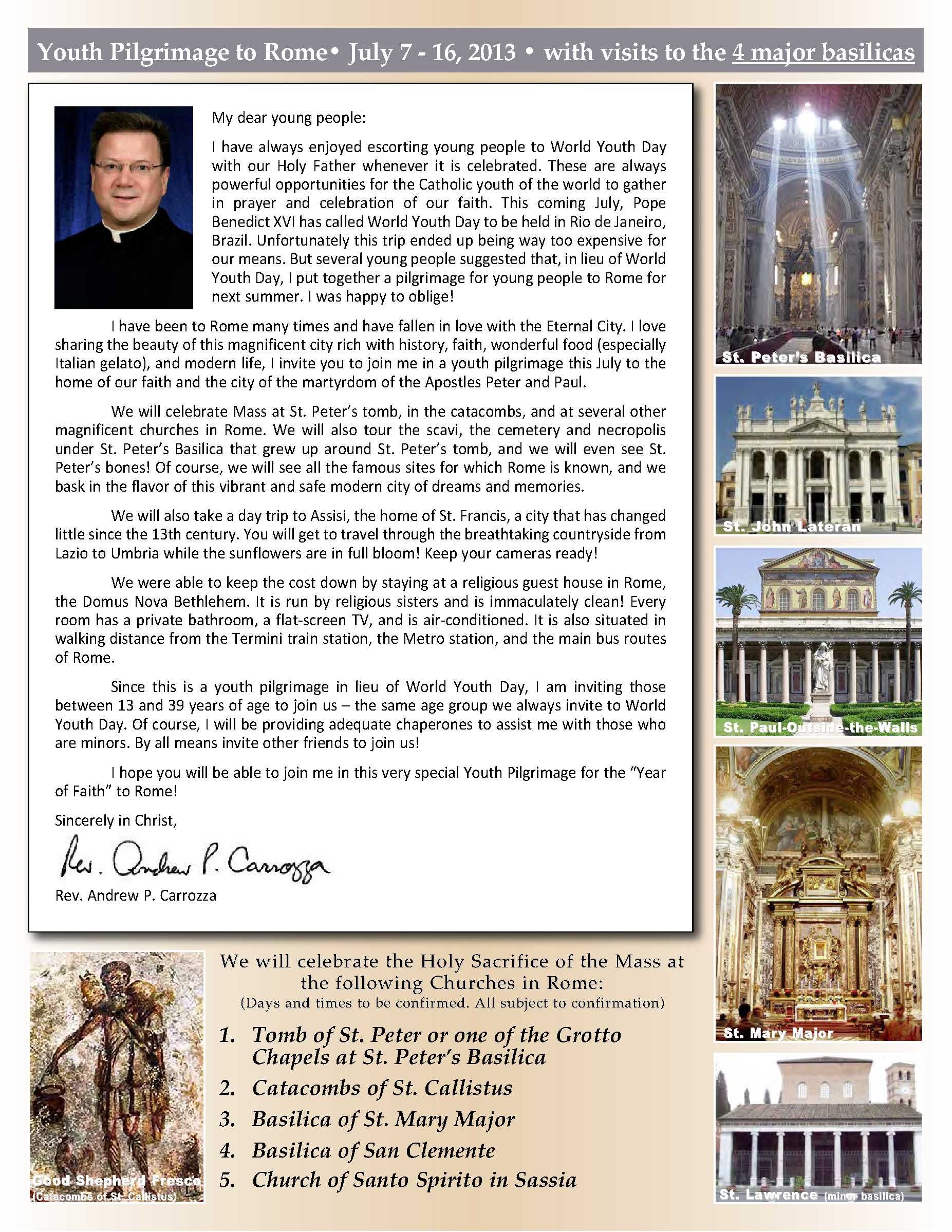
You are Going to Rome!!!!!!

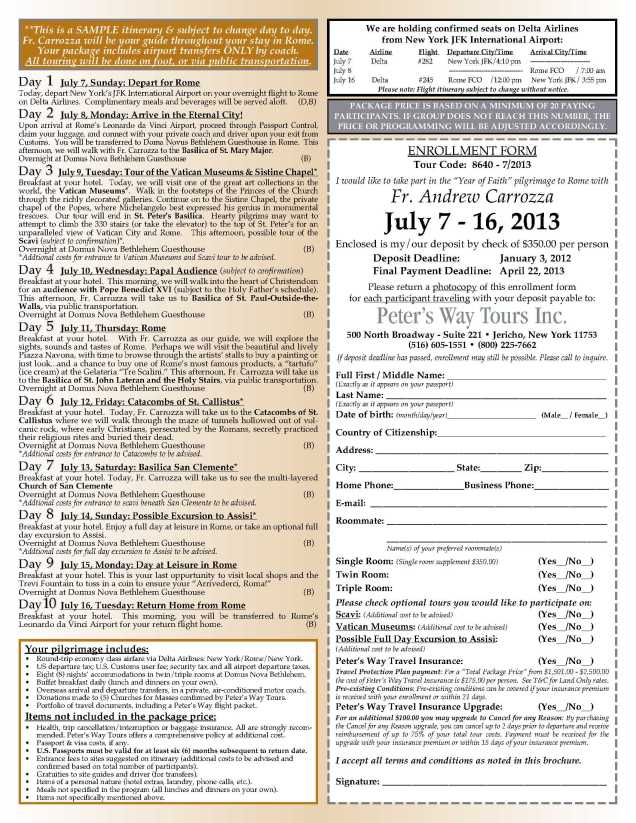
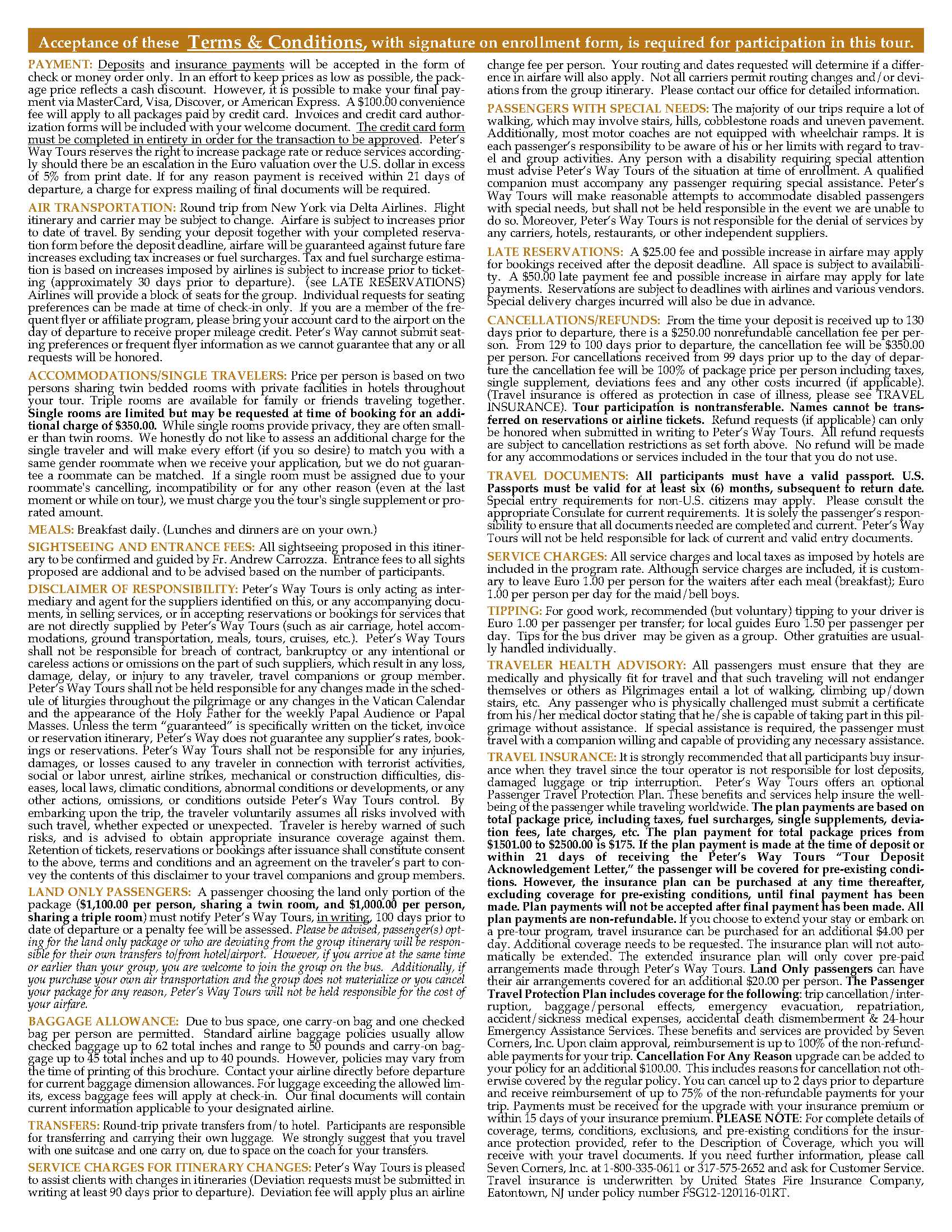
I am very pleased to announce that, at the suggestion of several young people I know, I will be leading a Pilgrimage for Youth to Rome this coming July. It will be open to anyone who is currently in 7th grade through those 39 years old. The flyer below gives all the information. If you’re interested in attending, simply sign up and send in your deposit. I hope you can join me in Rome!

Jesus the Wimp!

From time to time I enjoy reading comments people post related to internet news stories. Some are juvenile and insulting, but others are intelligent and well-written. Today a story appeared on MSN of yet another fragment of an ancient text that says that Jesus had a wife. Of course, many people immediately hauled out the worn-out canard that another proof that the Church is wrong has surfaced, and that the Church maliciously suppressed these documents because they showed a truth they didn’t want to acknowledge. Historians have always known that these documents existed, but they also have always known that they have no historical credibility. They were not written by people reporting what Jesus truly said and did. Rather, they were deliberately fabricated by groups such as the Gnostics in an attempt to make people believe the vision of Christianity that they desired to see but which Jesus did not in fact create. A married Jesus would suit their needs well, so they created it. The truth is that these documents were not delegated to the dustpans of history because they were ruthlessly suppressed, but because no one took them seriously, and they were simply abandoned as worthless.

But that’s not the point of this post. Instead, I wish to comment on what some people wrote in defense of the faith. Numerous people, in a valiant attempt to defend the veracity of the Church, pointed out that the heart of the Gospel is not whether or not Jesus married but his call to love one another. There were numerous posts of this nature: “God just wants us to love one another”, “Love God and love your neighbor”, “Be kind to one another”, etc. All of this is and true and good. But it is not the summation of the Gospel, and therein is where I think we have been weak in defending the faith and perhaps why it is not as popular is it should be.

I frequently receive responses from people stating that “Jesus understands” and “God just wants me to be happy.” The implication is that if Jesus loves us he’ll never allow us to be uncomfortable or suffer. Even parishes often avoid anything uncomfortable, and some priests have restricted their preaching to what I call “marshmallow theology” – soft, sweet, and fluffy, but containing no nutritional value. They limit themselves to preaching a sort of self-help psycho-spirituality, where you simply remember that God loves you and that you are special, so give yourself a big hug from God and remember how much he loves you! Well that’s nice and that’s true, but that’s Barney! Somehow I think the second person of the Blessed Trinity took on our human nature and died on the cross to teach us a little more than we can learn from a purple dinosaur! Some people even go so far as to think that Jesus doesn’t care about sin but only about how much we love him. I think Jesus cares about sin very much – enough to die on the cross to save us from it. Yes, God is all loving, all-compassionate, and all-forgiving. But there is more to God than that, and we frequently forget that side of him and have thereby presented the world with “Jesus the wimp!”

Any high school student playing a sport knows a good coach presses him to be the best he can be. At the time, the kid may not like it very much and may even curse out his coach. But when he wins a tournament or a medal, he is grateful that the coach pushed him even when he felt like he was at his limit, for he knows it was the coach’s belief in his potential and his constantly challenging him to be all he could be that made him succeed. Well, God is no different! Jesus loves us unconditionally and wants us to overcome sin and be strong against the devil. Yes, he tells us how much he loves us, but precisely because he loves us, he is not going to allow us to make excuses as to why we can’t do what he teaches us. He tells us the road will be rocky, but he will help us walk it. I specifically remember debating a young man who was gay who was trying to convince me that Jesus understood his plight and would allow him to have a homosexual relationship. He asked me, “What do you think Jesus would say to someone who told him he was gay?” His assumption was that Jesus would say, “I understand. Go out and love another man.” Instead, I told him I know exactly what Jesus would tell him, “Deny yourself, take up your cross and follow me!” Jesus is not a wimp, and the Gospel is not for wimps. To follow the Lord is a real challenge. Sometimes we forget to challenge people to be better than what the world says they can be. Maybe the fact that we have not presented people with the challenge but with a wimpy Jesus is a big part of the reason people don’t come to church any more. Who wants to worship a wimp?

Yes, following the Lord can be hard at times. If people have fallen into a deep pit, and one is able to climb out, what does he do for the others? He tells them that, yes the walls are steep and the climb will be difficult, but that is the only way to get out of the pit. He encourages them every step of the way to follow in his footsteps, as that is the only way to salvation. He doesn’t just sit on the rim and tell them to hold hands and sing Kumbaya!

Should a Catholic Vote for Obama or Romney?

Priests are often asked by parishioners which candidate in any particular election is the one that they as a Catholic should vote for. This year’s presidential election is no exception. If you’re reading this expecting me to tell you which candidate is the one you should vote for, you’ll be sorely disappointed. Yes, I have my opinion, and those of you who know me well enough should be able to figure out without any difficulty what that opinion is. But that’s not the point of this blog. In this article I wish to lay out principles Catholics should follow so that you can make the decision for yourself for whom you should vote.

First of all, let’s start by talking about a common mistake many people make: being enrolled in a particular political party, they automatically decide they will vote for their party’s candidate, and then look for reasons to justify their belief that their party’s platform is consistent with the Catholic faith. This has created some very strange, even ridiculous, tap dances by people and even politicians to try to soothe their conflicted consciences. Instead, we need to remember that our first allegiance is to Christ and His Gospel and not to any political party. (Not being myself enrolled in any one political party, I find a tremendous freedom in this arena!) Our choice should always be based upon which candidate best represents our beliefs. No candidate is probably ever going to score 100% agreement with everything we as Catholics believe. So we must figure out which are the principles we cannot compromise and are not open for debate and which we’d like to see but perhaps are not as significant as the others. In addition, we must consider the overall health of the nation spiritually, morally, and economically. It will of course be necessary to make concessions here and there, and we’ll have to be willing to tolerate a candidate’s position on one matter that we don’t like, simply because the alternative is a candidate whose position is unacceptable on a far greater matter. For example – and this is an extreme example I made up – one candidate may advocate a 50% tax on bubble gum to discourage children from chewing too much of it (which I think we’d all find silly), but his opponent, wishing to address the issue of illegal immigration, wants to station armed guards at the border authorized to shoot and kill on sight anyone trying to enter illegally. Even though I don’t like the bubble gum tax, I’ll take it over radical slaughter!

We also have to try and see the big picture and look down the line. Where will the particular policies of one candidate or another take us? If we embrace a certain position, what are the ramifications of that choice down the line? Is it leading us toward or away from our call to holiness in Christ? A healthy society needs to be strong economically, militarily, morally, and physically, but which of these is a priority, and when does one of these concerns outweigh the other? Sometimes that’s not easy to tell and there will be genuine disagreement among even faithful Catholics. That’s where healthy debate takes place.

So to sum up:

First, we must avoid knee-jerk decisions based on one-line promises and catchy sound bites, voting for a candidate simply because he is of “my party” regardless of how he stands on faith issues, or on nonsensical grounds. (One of my friends once told me she wouldn’t vote for a particular candidate because she didn’t like the look of his face and couldn’t bear to have to look at it on TV for four years – not the best reason to choose a candidate!) Instead, know the issues, the ramifications of them, and where each candidate stands on them.

Secondly, put your Catholic faith before party loyalty! There are some issues on which we can never compromise and it would be sinful for us to deliberately support any politician whose views contradict important Church teaching. To vote for a particular candidate who holds those views precisely because he holds them, as Pope Benedict XVI teaches, makes us ineligible to receive Holy Communion. The Holy Father has taught that only for grave reasons could one legitimately vote for a candidate who violates God’s gift of life and the dignity of every human being.

Thirdly, each candidate will have policies we like and policies we don’t. We must ask ourselves which of these policies are the most important according to our faith, and which ones may legitimately be sacrificed in order to allow a greater good to be protected.

Fourth, consider all elements together and PRAY about your choice before you make your decision, asking the Holy Spirit to guide you in making the right choice.

And finally, remember to vote! It is our duty! See you at the polls in November!

“I Should Live To Be 100!”

My great-grandmother’s 100th Birthday, September 3, 1990

“I should live to be 100!” How many times have we heard people say that? It appears we believe that those who live to a ripe old age have received a special blessing. I’m not so sure that is true. Those who die old are often neglected and forgotten.

Tomorrow I will celebrate the funeral Mass of a woman who died at 100 years old, and I just came back from the wake. Now, usually wakes are crowded places where the mourners are overwhelmed by people coming to pay their respect to the dead and to comfort the family. That’s terrific! That’s just what a wake is for! In addition to flowers and condolences, there is usually a pile of Mass cards from friends and acquaintances. Well, at this wake, there were only eleven people present – all members of the woman’s immediate family. This is by no means an exception; in fact, I would say it is the norm. All these people no doubt have friends and acquaintances that would be there if the person lost someone at a tender young age.  So where were they? Why do we not attend the wakes of the very old?

I think that somehow we decide that, since the person was very old, the family will be dealing with it better than if the person died young. To a certain extent this is true, and I certainly admit that, when a funeral is called in to the rectory and we hear the person was 100, that’s a lot easier to bear than if the person was 26. But that 100-year-old woman is still someone’s mother, someone’s grandmother, someone dear to them, and even if their grief is not as poignant as one mourning a child, they still have lost someone dear to them and can use our comfort. Even if we only stay at the wake for a few minutes, and even if we only can think to say “I’m so sorry for your loss,” that alone is so helpful to them. Our presence is reassuring that we care for them. And most importantly, as Catholics, the most important thing we do when someone has died is offer the Holy Sacrifice of the Mass for the repose of his soul, and people need prayers for their soul whether they die at 100 or at 20. So whenever you hear someone has lost a loved one, attend the wake, send a Mass card, make a phone call. The family will be grateful for your thoughtfuness and concern and might even need it, even if the person lived to be 100 years old.

With all the different religions out there, why should I choose to be Catholic?

Image

Years ago, I remember reading an article someone had written in the local newspaper to the effect that she was Catholic and her sister had become a Jehovah’s Witness. She mentioned how she struggled with her sister’s decision until she eventually reached the conclusion, “To each his own!” She said that being a Catholic worked for her, and if being a Jehovah’s Witness worked for her sister, then that’s great! Her ultimate conclusion was that everyone should find whatever religion he likes and stick with it, as they’re all fine. I disagree.

Religion is not a country club. Religion is our response to the revelation of God. We worship God according to the truth we believe he reveals about himself. Virtually every society on the face of the earth has come to believe in the existence of God. Many people have shown how belief in God can be deduced logically, and many of these arguments are quite compelling. But while we can logically deduce his existence, there is wide disagreement on what he is like. Ancient civilizations believed in many gods, and most of these were angry gods that needed to be appeased with sacrifices, incense, throwing virgins into volcanoes, even child sacrifice! If we came across such religions today, I don’t think any of us would merely say, “To each his own!” No, we’d be horrified! In time we’ve come to realize that certain religions are not true and have rejected them. But there are many others still widely practiced across the globe whose adherents will die for their belief that this is the truth. The beliefs of different religions sometimes contradict each other, thus they cannot both be true. For example, Hinduism believes in several gods, while Judaism, Christianity, and Islam believe in only one. Logic tells us that Judaism’s claim that God has said, “I am God, and there is no other” prohibits the possibility that we could reconcile Hinduism with Judaism. At most only one of them is revealing the truth about God, but not both.

So why be Catholic? I can best respond to that question by relating my own process of reasoning which led me to believe that the fullness of truth subsists in the Catholic Church.

When I was in the 7th grade, I was automatically launched on the program of preparation in my Catholic grammar school which would get me ready for the Sacrament of Confirmation. I was told about the “big decision” I was making to choose Christ and his Catholic Church. Being the person I was, I could never consent to anything without asking myself if I agreed with it. I therefore launched myself on an exhaustive soul-searching enterprise to see if this is in fact what I believed.

Since we are talking about religion and not science, I knew I had to start somewhere with a leap of faith. I certainly believed in the existence of God. I took the leap of faith to believe in the God of Israel. To me that made sense. With that as a foundation, I asked myself, “Okay, Judaism or Christianity?” I discovered that the crux in the whole question here was the person of Jesus. Israel had been longing for a messiah, and Jesus ultimately claimed to be that messiah. If he was truly the messiah, then Christianity was true; if he was a false prophet, I would be duty bound to become Jewish. It seemed obvious to me that the belief in the resurrection of Jesus from the dead was the key issue: did he or didn’t he rise? If he did, I felt he had proven himself to be truly what he said he was. If he did not rise, he was a fake. So could anyone prove he had risen from the dead?

It seemed strange to me at first that the accounts of the resurrection claimed that Jesus only appeared to his followers and not to Pontius Pilate, the Sanhedrin, Caiaphas, or King Herod. But then I realized that these unschooled men went out and boldly proclaimed to the very people they had previously been afraid of that they had seen Jesus risen on numerous occasions. They couldn’t have all been mistaken or have hallucinated. No, they firmly believed they’d seen Jesus risen, and they went to foreign countries preaching his name and died horrible deaths defending it. I couldn’t conceive of eleven of the twelve apostles willingly dying for something they knew they’d made up or if they couldn’t be sure they hadn’t hallucinated. No, they were crucified, boiled alive, sawed in half and skinned alive convinced they’d seen Jesus risen. That to me was proof! They wouldn’t have suffered so terribly for something they knew was a lie! So I realized I beleived in Christ. That also valdiated my leap of faith in the God of Israel. If Jesus rose from the dead, and he was the fulfillment of the promise to Israel, then the God who made the promise was real!

Okay, so I was a Christian, but how about Catholic? Many verses of scripture convinced me that Jesus gave the apostles his authority and sent them as his witnesses, and that we had to remain one with them and the tradition they handed down. That tradition is what Ignatius of Antioch first called “The Catholic Church” around the year 107 AD. I knew that, since Jesus had given his authority to them, only he could take it away. Even though there were periods in history when everything wasn’t rosy, when some of the popes and priests were not giving the greatest of example, even sinning terribly, that still didn’t take away the authority that Jesus gave them.

I thought of it this way: suppose a President of the United States committed a serious crime and had to be removed from office, maybe even sent to prison for his crime. He was an embarrassment to his Office, no doubt. But what do we do now? We get a new president! No one would say that the Constitution of the United States was rendered null and void by the sins of the president. Similarly, even if some popes had sinned and were a disgrace, that still did not remove the authority Jesus gave to St. Peter. In order for the Catholic Church to lose her authority to speak in Jesus’ name, Jesus himself would have to return to earth and formally remove it and give it to another. He never did that with Martin Luther, John Calvin, Henry VIII, Zwingli, or any other reformer, and none of them ever claimed he did! I therefore concluded that the Catholic Church still possesses the authority to teach in the name of Christ and not any of the other denominations of Christianity, that those who separated from the Catholic Church were not in full Communion with Christ, and I was therefore duty-bound to embrace the Catholic faith. On October 16, 1976 at 11 AM, I did so at my Confirmation and have not looked back since.

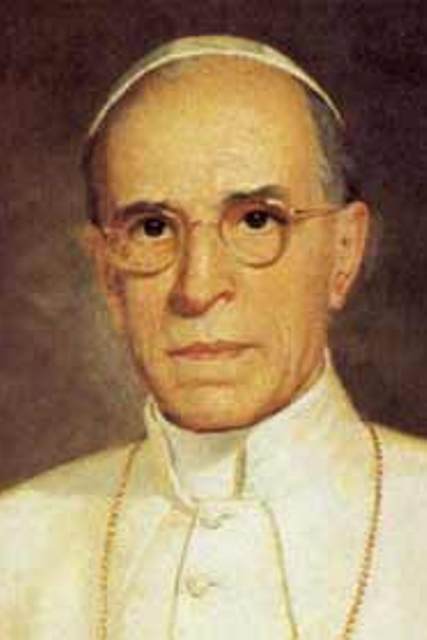
Was Pope Pius XII framed by the KGB?

The following is an excerpt from an article I found online by Edward Pentin, written on August 24th. I visited the Yad Vashem Holocaust memorial in Jerusalem this year, and was bitterly upset by their blatant depiction of Pius XII as having done nothing to save Jews during the Holocaust. They made only a passing mention that his role was controversial. The following adds support for the belief that he was in fact framed by the KGB and that the world has bought it.

When former Romanian intelligence chief General Ion Mihai Pacepa made sensational claims in 2007 that Pope Pius XII was the victim of a Soviet plot to frame him as a Nazi sympathizer, historians and even even some of Pius’s defenders were skeptical.

Yet as new evidence has come to light, Pacepa’s claims are gaining wider support. The former spy chief, who defected to the United States in 1978, has just completed a new book called “Disinformation” in which, together with Ronald Rychlak, an expert on Pius XII and the Holocaust, he explains how the intricate framing operation was carried out.

The book promises to paint an intricate picture of the nefarious methods and labyrinthine plots used by the KGB to frame anti-communists such as the wartime Pope. CIA director James Woolsey writes in the book’s introduction that it “will change the way you look at intelligence, foreign affairs, the press and much else.”

Its authors hope to show the extent to which the Kremlin’s disinformation campaign thwarted the truth becoming known about Pius XII — a Pope who, according to recently discovered historical evidence, saved more Jewish lives during World War II than any other religious and political leader combined.

Rychlak, a law professor at the University of Mississippi, was initially sceptical of a Kremlin plot, but rather than let the claims pass and fade away, he spent the next two years combing through documents to see if Pacepa’s claims would add up. “Bit by bit, all the pieces fell in place,” he told me. “The new picture answered many questions and made sense out of things that had previously been inexplicable.”

The former Romanian spy chief remains in hiding for his own protection, but through the Pave the Way Foundation, a charity that seeks to bridge sectarian divisions, he explained via email his proof of a KGB plot against Pius. But he said that to recognize such evidence of disinformation, “one should be familiar with the Kremlin’s very secret “science” of changing the past in order to suit current priorities.”

“In KGB jargon, changing the past was called “framing,” and it was a highly classified disinformation specialty,” he explained, adding that the operations were “like mosaics made up of hundreds or even thousands of tiny pieces fitted together.”

“Only a handful of master designers know how the final image will turn out,” he continued. “I was peripherally involved in changing the past of Pius XII, but at that time, even I did not know what the final image would look like.”

He gave examples of how such framing operations were executed, such as Stalin’s ruthless methods to falsify historical facts to fit into his own plans in the 1930s, and Pacepa’s own disinformation operations as head of Romanian intelligence in the 1970s. He explained how he managed to hoodwink Western heads of state, intelligence officers and others into believing that Romania’s dictator, Nicolae Ceausescu, was an admirable, pro-Western leader when, in fact, “he was a two-bit Dracula.” Ceausescu was executed by his own people in 1989, but Pacepa said that few in the West “looked back to speculate about how they had been so misled.”

His upcoming book, he explained, “contains solid, primary evidence documenting how the immense KGB disinformation machinery was able to flip the image of Pius XII from lily white to coal black — just as it flipped the image of Ceausescu in reverse.”

Pacepa further revealed how the framing of the ardently anti-communist Pope actually began in 1945. Concerned only for his own image, and fresh from victory after World War II, Stalin had one more enemy he wanted to defeat: the Ukrainian Catholic Church — the last Vatican enclave in the Soviet Union.

According to Pacepa, after persecuting the Church there, he set about trying to portray Pius XII as a Nazi collaborator, proclaiming on Radio Moscow in 1945 that Pius XII had been “Hitler’s Pope.”

But the campaign fell flat as those who knew Pius XII knew he could never have been a Nazi sympathizer. At the time, his wartime efforts to protect religious minorities were being roundly praised by such prominent world figures as President Roosevelt, Winston Churchill (who described Pius as “the greatest man of our time”), and Albert Einstein.

“They knew who Pope Pius XII really was,” Pacepa said. “[So] the Kremlin tried again in the 1960s, with the next generation, which had not lived through that history and did not know better. This time it worked.”

Central to that framing effort — codenamed Operation Seat 12 — was the 1963 theatrical play, “The Deputy,” written by the communist German playwright, Rolf Hochhuth.

Pacepa and Rychlak explain in the book that it had the KGB’s “hands all over it” and proceed to present evidence of deep Communist and Kremlin involvement in its promotion.

In his interview, Pacepa lamented that such disinformation methods continue to be used by Russia today, not least in its efforts to manipulate religions in order to consolidate its power.

Planned Parenthood wants our children to be sexually loose!

Here is the text of a letter to the editor I sent to our local newspaper:

Planned Parenthood Hudson Valley has posted a video on its Facebook page that shows several very young ladies – teens to early twenties – singing a parody of the song “Call Me Maybe” that begins with the following lyrics: “Met a guy at the mall, head over heels I did fall. I need to buy birth control, but now you’re in my way…I’ve never met you and this is shady. It’s my {female organ}, so hands off, crazy.” At first I thought it was a joke! But then I realized they were very serious about this message to young girls. So what they’re advocating is this: a young girl meets a guy at the mall and right away needs birth control so she can have sex with him. They used to have a name for girls like that! I ask every parent reading this to ask yourself this question: if your daughter were to tell you she was going to the mall, would you hand her a condom and say “Here! This is for you in case you meet a young man and want to have sex with him!”? Absurd! Planned Parenthood is now publicly advocating loose sexual morals among our young people. If this is what you as a parent want for your daughter, then Planned Parenthood is the group for you! But if have any desire for your children to learn responsible sexual behavior and to respect themselves, stay away from Planned Parenthood! Planned Parenthood has lost touch with today’s parents and is now encouraging harmful lifestyles to our young people. They don’t belong in our schools, and they don’t deserve to receive any public funds to advocate sexually irresponsible behavior to our young people.

If you care to view the video, here’s the link. But I warn you beforehand, it’s ridiculous and offensive! http://www.facebook.com/PlannedParenthoodHudsonPeconic. Click the video “hands Off, Crazy”

God would never forgive me THAT!

I frequently have people mention to me that they could never bring something into confession because they don’t think God will ever forgive them for what they did. Well, there are two things I usually say about this:

Suppose Adolf Hitler, right after he shot himself, had a moment of regret and asked God to forgive him. Do you think God would forgive him? They always respond, “of course!” (There would still be penance and Purgatory necessary, but God would forgive him.) If Satan himself should ever turn to God and say, “Father, I’m sorry for rebelling against you, and I’m sorry for harming your creation all these years! Please forgive me!” Would God forgive him? Again the answer is always, “of course!” So, I tell them, if God could forgive Adolf Hitler or Satan – with all the evil they did – do you think He will forgive you your sin, no matter how serious it is?” They immediately see the logic and say, “of course!” Remember that God is trying to get us into Heaven, not to keep us out!

Another help: When the Lord Jesus was revealing the Divine Mercy to St. Faustina, the priest who was her confessor was having difficulty figuring out whether the apparitions she reported were real or fantasy, so as proof, he asked Faustina to ask Jesus to reveal to her what the priest’s last mortal sin was. When she asked Jesus “What was Father’s last mortal sin?” Jesus responded, “I don’t remember!” Jesus did not die on the cross to hold us forever accountable for our sins but rather to take them away and forget about them! So don’t be afraid to bring your sins to Jesus for forgiveness, no matter how serious they may be. He WILL forgive you!

“Okay,” they may add, “but what if I keep committing the same sin over and over?” Well, one thing a priest is never allowed to ask you is “Will you promise me you will never commit that sin again?” He can’t ask that because you can’t promise that. All you can promise is that you’ll try, even if in the back of your mind you know you may fall again. Of course, if we have no intention of trying to avoid sin then we are not forgiven, but why would you bring it up in confession in the first place if you’re not sorry and are not even going to attempt to change?

“But does God ever get tired of forgiving us? Does He ever say we’ve exhausted our supply of forgiveness/ Will He ever say, ‘Hey! you’ve confessed this over and over and nothing changes! It’s time to bite the bullet and stop?'”

We might think He should – but He doesn’t! I find sometimes when I go to confession that the priest should say that to me, but he never does. God always forgives me, over and over and over, even if I don’t think He should. God has patience with me when I’ve lost patience with myself. That only tells me that God loves me even more than I love myself!

I came across an excellent video by Matt Fradd, a Catholic apologist, on this topic. It speaks of forgiveness, in this case for the repeated problem of viewing pornography. It is well worth viewing. Here is the link: http://mattfradd.com/2012/08/23/ive-confessed-this-1000-times/#respond

“Why Doesn’t the Pope Just Excommunicate All Those @#*&/!?+%’s!!!

From time to time I’ll read a letter to the editor or a column in a newspaper from someone accusing the Church of being wimpy, especially when it comes to dissent from Catholics on church teachings. They usually feel that the Pope should just excommunicate everyone who doesn’t tow the line. Well, yes, dissent is indeed a problem. I’m not merely talking about difference of opinion or people who don’t fully understand the church’s teaching on a particular matter; I’m referring to true dissent, where people know what we beleive and should be able to give full consent but instead dissent. So why doesn’t the Pope just excommunicate them all? Maybe today’s feast will help!

Today we celebrate the feast of two Roman martyrs, St. Pontian, pope, and St. Hippolytus, priest. Both were active in the early 3rd century. Hippolytus was frequently critical of the popes. He thought the popes were too soft on heretics and should excommunicate them all. Only a church of rigorously committed Christians was good enough for Christ and would survive, so anyone who was lukewarm should be spewed out of the Church’s mouth. While Hippolytus’ desire for faithful service to Christ is commendable, he seems to me to have made the mistake of holding up the goal as the starting line. Somehow he seems to have expected everyone to be automatic saints, rather than realizing that saithood is the goal we strive for. As a result, he became “holier than the Church” and a self-appointed defender of the truth, even against several popes! When Pope Zephyrinus refused to make a definitive statement condemning a heresy (because the Pope did not yet feel it was sufficiently understood to warrant condemnation), Hippolytus gravely censured him, representing him as an incompetent man, unworthy to rule the Church of Rome and as a tool in the hands of the ambitious and intriguing deacon Callistus. Consequently when Callistus was elected pope on the death of Zephyrinus, Hippolytus immediately left the communion of the Roman Church and had himself elected antipope by his small band of followers. These he called the Catholic Church and himself successor to the Apostles, terming the great majority of Roman Christians the “School of Callistus.” He accuses Callistus of having through avarice degraded ecclesiastical, and especially the penitential, discipline to a disgraceful laxity. Hippolytus continued in opposition as antipope throughout the reigns of the two immediate successors of Callistus: Urban  and Pontian. During the persecution by the Emperor Maximinus, Pontian and Hippolytus were sent into exile in the salt mines of Sardinia. While there, Pontian was able to work his charm on Hippolytus and help him see the errors of his excessive rigorism. Hippolytus made a full confession, renounced his claim to be the pope, was completely reconciled with the church, and died a martyr.

Did you notice that Hippolytus, in his desire to try to get everyone else excommunicated, actually was in the very position he berated? I’m sure there were many people wondering why the Pope didn’t excommunicate Hippolytus! Pope Pontian had a better idea: reconciliation. He remembered that, as shepherd of the flock, his first duty is to try and bring back those who stray and correct their errors so as to bring them back into the loving embrace of Christ, not to kick everyone out who disagrees. Sometimes an excommunication is necessary, either to help the person see the error of his ways and bring him back – the primary desire of using this censure, as a medicinal device – or in extreme cases, like when one has a gangrenous toe, to cut it off so as to protect the health of the rest of the body.

We can all disagree about when something has gotten so bad that the Pope has no choice but to excommunicate someone, but that needs to be a last resort and not an immediate reaction. Our desire is to call every soul to salvation. No one is outside the call to reconciliation with Christ. If we must resort to excommunicating someone to bring him back to his good senses and back into the fold, so be it, but we should only use excommunication as a final solution when it is absolutely necessary for the health of the rest of the body and we have no choice otherwise.