Here is one time I hate being right – polygamy is now legal!

In a previous post I wrote that the legalization of gay marriage was just the tip of the iceberg, and I warned about what was waiting in the wings. Some people scoffed at my prediction. Well, my predictions are coming true!

An activist federal judge ruled on Friday that polygamy is now essentially legal in the United States. U.S. District Judge Clark Waddoups recklessly decided that reality TV stars Kody Brown and his four “wives” could not be prosecuted for polygamy, even though the Utah law against the practice is the strongest in the nation. So now, watch! State after state will start legalizing polygamy (including polyamory – three men and two women, for example – it’s the same thing!) and we will be branded as “polyamorophobes” because we oppose it.

I warned from the beginning that once the biblical standard of man-woman marriage was breached, there would be no logical place to stop. Though we as Catholics have been accused of exaggerating and scare-mongering, this ruling shows that we were right all along to sound the alarm. The next in line to be overturned will be bans against incest. After that, bestiality (zoophilia)! Just watch! Don’t believe me? No one believed me when I said polygamy would be accepted. Pandora’s Box is open! All the evils are now out and free! God save us! We obviously can’t leave it up to ourselves to know right from wrong! My biggest fear is that I’m being proven right far sooner than I ever imagined! Do you still think there was nothing wrong with legalizing gay marriage?????


The Catholic Faith in a Nutshell

ImageI was having dinner with a friend the other night who is not Christian but who was asking me a lot of questions concerning what our Catholic faith is all about. When I explained it to him, he said I pretty much captured it in a nutshell. Since he found it helpful, I thought it might help someone else by posting it on my blog, so here goes!

 With Original Sin, Heaven was lost to mankind. Satan had his entry into our world, and with him came his greatest weapon: death. No matter how good any one of us tries to be, because of Original sin, when we die, we would enter into Hell and condemnation for all eternity, and there was nothing we could do about it. A good image would be of us being thrown into a prison and shackled to the wall with the door slammed shut behind us. With Satan, all our pleading and begging for mercy to let us out falls on deaf ears. The only one who can help us is God. We need his help; without him we’re doomed. God did come to our help by becoming a man. He took on our human nature precisely so that now he could enter the realm of death, something he couldn’t do as God alone. He took on flesh in the person of Jesus, who is both truly God and truly man. When he died on the cross – which was his plan from the beginning – he was able to enter into Hell and free us. You can imagine it as Satan letting the one person in who had the key to our shackles and the gate to Hell. When he rose from the dead, he destroyed death’s hold over us. It’s as if Jesus paved a highway that goes right through Hell and up to Heaven. So Jesus totally reversed the power of death by taking Satan’s prime weapon and turning it against him. What Satan intended as the means to enslave us in his kingdom – death – is now the way we leave his power and enter into heaven. We will still die, but death now leads to our salvation and not our condemnation. But in order for us to follow the path, we have to be one with Jesus. God took on our nature, and now we must take on his. This is accomplished through the Sacraments. In Baptism, we die with Christ and are buried with him, but we also rise with him. We inherit heaven and become heirs with Christ to everything he won by his death. In the Eucharist, Jesus gives us his body and blood as our food so that our flesh is now made up of his flesh, and every time we celebrate the Holy Sacrifice of the Mass and receive Jesus in Holy Communion, we are on the cross with him in an unbloody and painless manner, are buried with him and risen in him over and over again. It’s as if Jesus created a power line that transverses eternity for us to plug into his death and resurrection and receive the salvation he won for us once and for all. He made the sacrifice he offered on Calvary forever present to us in the Holy Mass. He also gave his teachings to the Apostles with the authority to continue these Sacraments for all of time, and told them to “teach them to carry out everything I have commanded you.” (Matt. 28:20) We still have to walk the path to heaven – there is no moving sidewalk that automatically takes us there – and sometimes, because while Baptism washes away Original Sin, concupiscence (the inclination to sin) still remains – we stray from the path. Christ calls us back to the right path constantly through the Sacrament of Reconciliation, and teaches us through the Church, especially the successor to St. Peter (the Pope) to whom Jesus gave the ultimate authority to speak in his name (cf. Matt. 16:13-20), to help us know when we’re not sure if certain activities or beliefs lead us to heaven or not. So, in order to reverse the effects of Original Sin, we must accept Jesus as God-made-man, be baptized, receive him in Holy Communion every Sunday for the forgiveness of our sins, and allow him to keep us on the path to heaven by following the way he shows us through the teachings of the Church. Do that and you’ll get to Heaven. It’s as simple as that!

P.S. Thanks, Joe, for the inspiration!!

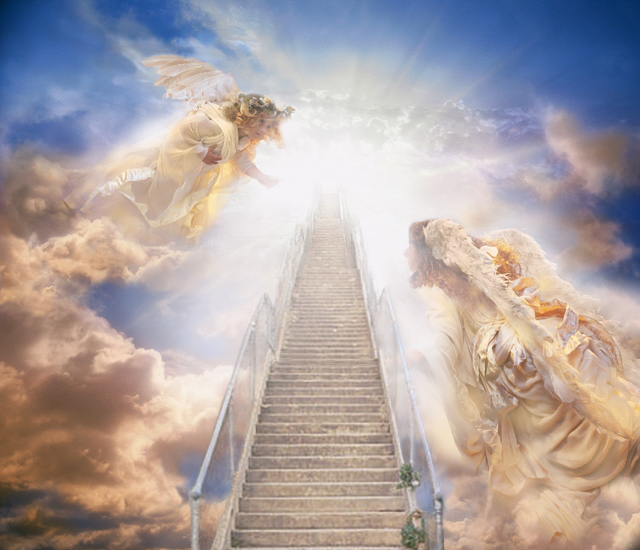
Do You Want To Go To Heaven?

led-zeppelin-stairway-to-heaven1

“Do you want to go to heaven?” Anyone who believes in God would almost certainly answer that question with a “yes!” No one who believes would desire anything else. So why, then, do we have to worry about going to heaven? Some people mistakenly hold that, “since God is all-loving, what loving God would want us to burn in hell for our sins rather than be with him in his kingdom? He wouldn’t deliberately condemn any of his children; therefore, everyone will go to heaven!” Unfortunately, that’s not a correct read on God, as they leave out one very important element: free will. Yes it is true: God desires the salvation of everyone. His death and resurrection made that possible for all of us. But in order to enter heaven, we must follow him. That is up to us.

Imagine if you will a ship that has come to rescue people who were tossed overboard in a shipwreck. The ship anchors and sends a ladder down into the water for everyone to climb up to safety. Many people do, but others, for whatever their reason, refuse to climb the ladder. Maybe they are enjoying the water and see no reason to get on the ship, or maybe they’re expecting the captain to jump into the water and drag them out personally. They argue, “The captain doesn’t want us to drown, so he’ll jump in and pull each of us out of the water.” And so they stay treading water waiting for the captain to save them. The ladder is still there and the captain is saying, “Come on! Grab onto the ladder and climb up onto the ship!” but the person says, “No, I don’t have to because I know you’ll come down and get me!” Well, what happens? Glug! Glug! Glug! The person drowns. Did the captain deliberately drown the person because he refused to climb the ladder? No, he is very upset by the fact that the person drowned, but it was the person’s own fault. So those who were saved were saved because the captain threw down a ladder to make their rescue possible. As for those who weren’t saved, it was their own fault!

It is the same way with God. By becoming man and suffering, dying, and rising for us, he made our salvation possible. But you and I have to freely avail ourselves of what he offered in order to enter heaven. Remember that, while we often think of heaven as this big banquet going on in heaven, theologically speaking, “to go to heaven” means to be perfected, to be perfectly formed in the image and likeness of Christ, to be totally present to him. What needs to be perfected? Our muscles? No. Our hairdo? No. Obviously, it is our will. Original Sin occurred when Adam and Eve said no to God and yes to sin. Our salvation is when we reverse that, when we say no to sin and give our full assent to God’s will. Now, if God were to force us to follow him, that would not be our free will, our own consent; it would be coercion. So God cannot drag us by the hair into heaven whether we want to enter or not – he can’t force us to be perfected. He will help us, but it has to be our own choice. Hence, anyone who is saved is saved by the grace of God; anyone who is not, it is his own fault! God saves those who are saved; the condemned man, by his own refusal to follow God, condemns himself!

So therefore, no one can sit back and rest on his laurels thinking his salvation is in the bag. We must work on it every day by following God’s law. Yes, he desires our salvation and he helps us in a thousand ways every day to walk the path, to climb the ladder out of the waters of death, but we have to walk, we have to climb. He cannot do it for us.

Respect Life – but don’t shoot the priest!

This Coming Sunday the Church celebrates Respect Life Sunday. It is the weekend every year when we are asked to reflect upon the sanctity of human life in all its stages, from conception to natural death. Of course, whenever we talk about the precious gift of life and the crimes against it in our society, we know we will meet opposition, sometimes even within our own household. This fact has often put the priest in a great dilemma at mass. Some people, aware that some Catholics in church on Sunday do not take defense of life seriously, expect the priest to give a fiery condemnation of abortion, euthanasia, and all other crimes against human life. For them only a frontal attack will do. I would be the last person in the world to deny the seriousness of these practices, and I too sometimes get angry when I see Catholics taking them lightly. But I also know that there are people in our congregation who have had abortions. Some regret them terribly, and a strong condemnation only digs the knife of their pain deeper in their heart. Others do not regret it, or at least not as severely, and can end up feeling that the priest is trying to make them feel guilty when in fact they don’t. So a strong attack will not benefit them. Then there are some who do not want to even talk about it because they don’t want their children to have to hear about it. But by never talking about it, we fail to instruct our children from an early age to respect life and deprive others of possible tools to help them make life-affirming choices should they or someone they love be in a crisis situation. So the priest is often stuck between the barrels of the shotguns of two groups: one demanding that he preach strongly and condemningly against abortion and the other demanding that he never mention it at all. So what should the priest do? Well, I always ask how Jesus would handle it. I believe first of all that Jesus would undeniably affirm the sanctity of every human life, and that it is never permissible for us to take or prevent any human life. I think he would be very strong when confronted with those who advocate doing so. At the same time, he would be most forgiving and comforting to those who have submitted to any life-denying actions and now regret it, and if he needed to bring the person to realize the error of their ways, he would do it with tremendous charity. That’s what I try to do, and I suggest we all do the same. So if at any time your priest does not speak about life matters in the manner you would wish, I plead with you not to shoot him and make him the source of all evil, whether it is the accusation of keeping silent and allowing evil to triumph or of talking about it and upsetting children and making others feel guilty. Remember that the priest is not the source of the problem of lack of respect for life. It is a sad reality in our world that we must discuss unpleasant matters at times, even if it makes some people who don’t want to hear it uncomfortable, but at the same time we cannot come out like gangbusters bashing everyone; we must be sensitive to the needs of all parishioners. Let us strive to advocate respect for all life in uncompromising fidelity to the truth but also with tremendous understanding and compassion. I think that’s what Jesus would do!

How does one become a saint?

I just got back from Rome last night, and while there, I could not cease to remember seeing Pope John Paul II several times on previous trips to Rome and reflecting on how I saw and met a future saint. With the recent news that Pope Francis will canonize Pope John XXIII and Pope John Paul II, a lot of attention will be focusing on the process of being declared a saint. The blog whose link I have attached below does an  excellent job in relating the process.

One thing I always find necessary to point out is that the Church doesn’t make saints: we declare them. A saint is someone in heaven. When someone is canonized, it means that God has given us sufficient indication that the individual is with him in glory, and that their life was so exemplary of the life of discipleship in Christ that we should pause and reflect upon their life, as it will help us on our journey.

Undoubtedly, someone will point out a sin the person once committed and think this automatically rules the person out for sainthood. Not true. We don’t canonize people for being sinless; we canonize them for practicing heroic virtue, which clearly both John XXIII and John Paul II demonstrated amply in their lives.

The link below describes the canonization process:


http://www.focus.org/blog/posts/how-does-someone-become-a-saint.html

The Supreme Court and Pandora’s Box

Watching the news stories of people celebrating the Supreme Court’s decision to override certain elements of the Defense of Marriage Act (DOMA), which in effect legalizes gay marriage, I can’t escape the analogy of watching people celebrate as the Trojan horse is wheeled through the gates of Troy. While this ruling will be perceived as a great victory by some people because it validates their desires, there is a host of evils hiding within that, once they are out, I guarantee you people will regret tremendously, and will begin to rue the day the Supreme Court overstepped its bounds and had the audacity to redefine what constitutes a marriage. Same sex marriage is just the tip of the iceberg. What is waiting in the wings is terrifying. Observe the following:

  1. A lawsuit being referred to as the “Sister Wives” lawsuit because the persons involved with the lawsuit are the ones who are in the TLC reality show of the same name, is being filed in Utah. Kody Brown and his four wives believe the bigamy law in Utah – which does not allow a man to have more than one wife – is unconstitutional.
  2. A woman who calls herself “Ashara Love” defending polyamory and pushing for the right to marry, explains: “We are the next generation after the gay and transgender communities.”  She belongs to a small group that believes people have the right to form their own complex relationships with multiple partners. The most vocal want the right to marry as a cluster. “We have rights to love any way we want unless we are harming other people,” said Love. “Like the air we breathe, we have a right to be and do and say whatever is our full expression, and this to me is a civil right.”
  3. On Nov. 16, 30-year-old office worker Chen Wei-yih married the love of her life — herself. The Taipei City-based woman, who is no longer single by her own admission, wanted to show other ladies who have hit their thirties without a manifested prince charming that they are not failures. “You must learn to love yourself before you can love others,” said Chen, who also embarked on a solo honeymoon to Australia. Chen explained that when a woman in Taiwan enters her thirties, getting married and having children becomes the main focal point among concerned family, relatives and friends, making a single, independent woman feel like a failure if she has none of those things. Chen explained that “although many people freely express their love for others through flowers, chocolates and expensive dinners, they are less inclined to pamper and shower the same love on themselves. By the same token, expressing your love for a man through marriage and a huge wedding banquet should be something you’re willing to do for yourself. Self-marriage seemed like the logical solution”, she concluded. Making it clear that she has had several boyfriends and relationships, some of which almost led to the altar, Chen described herself as neither unmarriageable nor against marriage to another person. She also considers this marriage non-binding, meaning she is free to marry someone else, but if that opportunity does not arise, at least she made the commitment to forever love herself.
  4. A blog entitled “Full Marriage Equality”, which defines itself as “Advocating for the right of consenting adults to share and enjoy love, sex, residence, and marriage without limits on the gender, number, or relation of participants” and states that “full marriage equality is a basic human right” makes a forceful argument to legalize consensual incest: “In the twenty first century family, we have made progress in leaps and bounds. Interracial couples are accepted, gay rights are improving and ‘acceptance’ is the catch-cry of our generation. But it seems strange that while we have come so far in breaking down these social barriers, we have built other walls. Incest, which was common amongst Ancient Egyptians and monarchs up until a few hundred years ago, is now a social taboo…the thing that really stands out though is that no matter the situation, two or more convictions for incest puts you on the Sex Offenders Register for the rest of your life. ‘Consent’ is not a valid defense. The love of your life can be standing in a witness box, telling the court he loves you, and that it was consensual, but it doesn’t matter…Incest is mainly illegal because there’s a law saying it is. It’s not exactly harmful to participants or their children. You just have to remember that incest and abuse are not synonyms.”
  5. Animal sex advocate Malcolm Brenner is republishing a memoir he wrote about a nine-month sexual relationship with a theme park dolphin. Brenner asks, “What is repulsive about a relationship where both partners feel and express love for each other? I know what I’m talking about here because after we made love, the dolphin put her snout on my shoulder, embraced me with her flippers and we stared into each others’ eyes for about a minute.” Activist Cody Beck compares talking about his attraction to dogs and horses to a gay teenager coming out. Harboring a crush on a Dachshund is “like being gay in the 1950s. You feel like you have to hide, that if you say it out loud, people will look at you like a freak.” Beck says that he and a network of zoophile or “zoos” are the logical extension of the sexual rights movement.

Of course, some people will scoff at the idea that any of these perverse acts will ever be legalized. But the reality is that, given the language used to argue same sex marriage rights – “my civil rights”, “the right to love whomever I choose”, “as long as it’s not harming anyone else” – what foundation is left to prohibit these actions? It is completely eroded away, and it is only a matter of time before the tide of public opinion becomes less hostile to people with these desires and more compassionate and understanding of their “needs” and fights for their rights to marry their sister or their dog. Pandora’s Box has been opened wide!

What I find most interesting (or appalling) in all of this is what has happened to the definition of marriage. If we put all this together, what is society proposing as the new definition of marriage? It would appear to be something like this: “Marriage is a bond of love between one, two or more persons of either sex or with a non-human that may or may not be expressed sexually, that can be permanent if you want it to be or temporary – whichever you prefer. It may be a pledge of fidelity to another person, unless you don’t want mutual exclusivity, in which case you are free to love as many people as you wish.” In other words, “create whatever relationship you’d like and call it a marriage.”

Contrast this with the Christian understanding of marriage that has been the foundation of Western society. That view is that God created Woman from the side of Man to show that the two come from one flesh: This one “at last is bone of my bones and flesh of my flesh…that is why a man leaves his father and mother and clings to his wife, and the two of them become one body” (Gen. 2:23-24). Add to that the Catholic understanding that in marriage, a man and woman who give themselves to each other sexually are uniting their love with the very love of God, who through them may bring a new life into the world, thereby drawing them into union with the very essence and nature of God and by that act receiving tremendous grace and leading their souls to heaven.

If this new contemporary definition of marriage is allowed to grow and mature, what will we have achieved? There are many legitimate needs that some people face in a society where they cannot enter into marriage with a member of the opposite sex, but they can be met in various other ways without loosely defining any relationship we wish as a marriage. My question is this: is the contemporary ambiguous redefinition of marriage worth throwing away the Christian view of marriage that we have held until now? Where is the improvement? Perhaps we need to discuss the very real possibility that God knew what He was doing when He instituted marriage as a sacred covenant between one man and one woman, and that any attempt on our part to address the legitimate needs of anyone who doesn’t fit this model, no matter how compassionate and understanding we are, will not be solved by redefining marriage to meet their personal desires.

The only hope we have left is for enough people to open their eyes to the reality of the direction in which we are headed and start to acknowledge once again that marriage must only be between one man and one woman. It’s time we lose the egos that have dared to tell God he’s wrong and that we’re going to correct his error. Perhaps we can still round up the evils and put them back in Pandora’s Box before it’s too late. God help us if we don’t!

Either marriage is heterosexual and monogamous or it is totally meaningless. We cannot have it both ways. Which do you prefer?

Can God make a square circle?

Have you ever had someone – usually an atheist – try to argue against the existence of God by asking “Can God make a square circle?” or “Can God make a rock so heavy he cannot lift it?”  They assume they’ve found a solid argument against the existence of God and have us trapped! We all know that this is nonsense, but would you know how to respond to the question? Catholic apologist Matt Fradd does a great job answering this in his blog. Check it out:

http://mattfradd.com/2013/06/17/god-rocks-and-square-circles/

The Eucharistic Miracle of Buenos Aires and Pope Francis

Throughout the history of our church, there have been reported miracles of the Eucharist. The first known one was the Miracle of Lanciano, Italy, about 700 AD. This miracle still baffles scientists to this day. Here is an account of a Eucharistic miracle that Pope Francis approved when he was Archbishop of Buenos Aires. The facts of what took place are narrated by Ron Tesoriero in his book Reason to Believe, published in 2007.

In 1996 in the Archdiocese of Buenos Aires, Argentina, when the present Pope Francis was Auxiliary Bishop under Cardinal Quarracino, an amazing Eucharistic miracle took place. He himself had it photographed and investigated and the results are astonishing.

At seven o’clock in the evening on August 18, 1996, Fr. Alejandro Pezet was saying Holy Mass at a Catholic church in the commercial center of Buenos Aires. As he was finishing distributing Holy Communion, a woman came up to tell him that she had found a discarded host on a candle holder at the back of the church. On going to the spot indicated, Fr. Alejandro saw the defiled Host. Since he was unable to consume it, he placed it in a container of water and put it away in the tabernacle of the chapel of the Blessed Sacrament. On Monday, August 26, upon opening the tabernacle, he saw to his amazement that the Host had turned into a bloody substance. He informed Bishop Jorge Bergoglio (Now Pope Francis, Auxiliary Bishop at that time), who gave instructions that the Host be professionally photographed. The photos were taken on September 6. They clearly show that the Host, which had become a fragment of bloodied flesh, had grown significantly in size. For several years the Host remained in the tabernacle, the whole affair being kept a strict secret. Since the Host suffered no visible decomposition, Cardinal Bergoglio (Who became Archbishop by that time) decided to have it scientifically analyzed. On October 5, 1999, in the presence of the Cardinal’s representatives, Dr. Castanon took a sample of the bloody fragment and sent it to New York for analysis. Since he did not wish to prejudice the study, he purposely did not inform the team of scientists of its provenance (the source of sample was kept secret to the scientists). One of these scientists was Dr. Frederic Zugibe, the well-known cardiologist and forensic pathologist and former Medical examiner of Rockland County. He determined that the analyzed substance was real flesh and blood containing human DNA. Zugibe testified that the analyzed material is a fragment of the heart muscle found in the wall of the left ventricle close to the valves. This muscle is responsible for the contraction of the heart. It should be borne in mind that the left cardiac ventricle pumps blood to all parts of the body. The heart muscle is in an inflammatory condition and contains a large number of white blood cells. This indicates that the heart was alive at the time the sample was taken. It is my contention that the heart was alive, since white blood cells die outside a living organism. They require a living organism to sustain them. Thus, their presence indicates that the heart was alive when the sample was taken. What is more, these white blood cells had penetrated the tissue, which further indicates that the heart had been under severe stress, as if the owner had been beaten severely about the chest.
Two Australians, journalist Mike Willesee and lawyer Ron Tesoriero, witnessed these tests. Knowing where sample had come from, they were dumbfounded by Dr. Zugibe’s testimony. Mike Willesee asked the scientist how long the white blood cells would have remained alive if they had come from a piece of human tissue, which had been kept in water. They would have ceased to exist in a matter of minutes, Dr. Zugibe replied. The journalist then told the doctor that the source of the sample had first been kept in ordinary water for a month and then for another three years in a container of distilled water; only then had the sample been taken for analysis. Dr. Zugibe was at a loss to account for this fact. There was no way of explaining it scientifically, he stated. Also, Dr. Zugibe passionately asked, “You have to explain one thing to me, if this sample came from a person who was dead, then how could it be that as I was examining it the cells of the sample were moving and beating? If this heart comes from someone who died in 1996, how can it still be alive?”
Only then did Mike Willesee inform Dr. Zugibe that the analyzed sample came froma consecrated Host (white, unleavened bread) that had mysteriously turned into bloody human flesh. Amazed by this information, Dr. Zugibe replied, “How and why a consecrated Host would change its character and become living human flesh and blood will remain an inexplicable mystery to science; a mystery totally beyond her competence.”
Then Doctor Ricardo Castanon Gomez arranged to have the lab reports from the Buenos Aires miracle compared to the lab reports from the Lanciano miracle, again without revealing the origin of the test samples. The experts making the comparison concluded that the two lab reports must have originated from test samples obtained from the same person. They further reported that both samples revealed an AB positive blood type. They are all characteristic of a man who was born and lived in the Middle East region.

Only faith in the extraordinary action of a God provides the reasonable answer: faith in a God, who wants to make us aware that He is truly present in the mystery of the Eucharist. The Eucharistic miracle in Buenos Aires is an extraordinary sign attested to by science. Through it Jesus desires to arouse in us a lively faith in His real presence in the Eucharist. He reminds us that His presence is real, and not symbolic. Only with the eyes of faith do we see Him under appearance of the consecrated bread and wine. We do not see Him with our bodily eyes, since He is present in His glorified humanity. In the Eucharist Jesus sees and loves us and desires to save us.

The Eucharistic Miracle of Buenos Aires

The Eucharistic Miracle of Buenos Aires

If I consult a medium, is it a small matter, or am I committing a large sin?

What Does the Church Teach About the Occult?

fortune teller

(Horoscopes, Ouija Boards, Fortune-tellers, Psychics, Wicca, Mediums, Séances, etc.?)


Question: Is it morally acceptable for Christians to involve themselves in various forms of fortune telling and divination, including superstition and reading horoscopes?

Answer: No. The Church teaches that all such activities are sinful. Of course, the sinfulness varies depending on the type and intensity of the activity practiced, but all are contrary to the faith. The Scriptures clearly condemn such activity. The Book of Deuteronomy states: “Let there not be found among you anyone who immolates his son or daughter in the fire, nor a fortune-teller, soothsayer, charmer, diviner or caster of spells, nor one who consults ghosts and spirits or seeks oracles from the dead. Anyone who does such things is an abomination to the Lord” (Dt.18:10-11). The penalty for such activity was rather severe: “A man or a woman who acts as a medium or fortune-teller shall be put to death by stoning; they have no one but themselves to blame for their death” (Lv.20:27). St. Paul reaffirms this prohibition: “…the works of the flesh are obvious: immorality, impurity, licentiousness…idolatry, sorcery…. I warn you, as I warned you before, that those who do such things will not inherit the kingdom of God” (Gal.5:19-21). Finally, the 1994 Catechism of the Catholic Church repeats the prohibition on all forms of divination and occult practices: “All forms of divination are to be rejected: recourse to Satan or demons, conjuring up the dead or other practices falsely supposed to “unveil” the future. Consulting horoscopes, astrology, palm reading, interpretations of omens and lots, the phenomena of clairvoyance, and recourse to mediums all conceal a desire for power over time, history, and, in the last analysis, other human beings, as well as a wish to conciliate hidden powers. They contradict the honor, respect, and loving fear that we owe to God alone” (Catechism, 2116).

Why is this so?: Following horoscope, etc. is putting our faith and the authority over our lives in the hands of someone or something other than God. In general, people who are content in their life and at peace in the sight of God do not tend to delve into the occult. People looking for answers to difficult questions, for an end to some pain or suffering, or who are hopelessly curious tend to turn to such activities. Even if they don’t intend it at first, once they start to ascribe any power whatsoever to such activities, they begin to question the power of God. They start to find hope in some power outside of God, and if these sources can provide immediate answers to their questions, then why bother going to God at all, since God’s way is so difficult and takes so much more effort to discern? Fortune telling is seen as infinitely easier. As a result, their life begins to be governed, not by prayer and following the Gospel, but by tarot cards and psychics. In the end, they become involved in blatant idolatry, sometimes even worshipping false gods (such as in Wicca), and always ascribing the sovereignty over their lives to another power, a sovereignty which is supposed to be given to God alone.

Objection: But I don’t really mean anything by it. I read my horoscope and call psychic hotlines just for fun. Is it a sin even if I realize it’s not real?

Answer: Yes, it is. Even flirting with such things can be dangerous. Suppose one morning you read your horoscope and it says you will come into a lot of money that day, and just by coincidence you go to work and get a raise, or find $10 on the sidewalk. You may be tempted to say to yourself, “Gee! My horoscope said this would happen! It was right!” The next day, you end up reading your horoscope with a little more credibility, and if you should find a second “prophecy” that comes true, you’ll start believing it. What’s more, when we start to be convinced of the legitimacy of horoscope, palm reading, psychics, etc., we can even make them come true. We start reading everything that happens as fulfilling the prediction. Getting a parking space in the first row at the mall starts becoming the “good fortune” we were told was coming our way, and then we’re hooked! Our lives are now being controlled not by our prayerful actions before God, but by horoscopes, ouija boards, and all types of devices outside our control. It can become addictive just like drugs, and as anyone recovering from a drug addiction will tell you, the best way to break an addiction is to never start!

Question: Are psychics, ouija boards, tarot cards, etc. real? In other words, do they really have these powers, or are they fakes?

Answer: Certainly many of them are frauds. But are all of them? Perhaps no one can truly answer this question definitively. If the power is in fact supernatural, if it comes from God, it is being used in a way God has not instructed, and if it is not from God, guess where it’s from! Some have suggested that psychic and clairvoyant powers are not supernatural at all, but merely the ability of some individuals to use part of their brains which most of us cannot. Whether or not this is true, and irrespective of whether their power is real, supernatural, or phony, the end is always the same: we place our trust in something God has forbidden, and that is never to our advantage. Consider this case: I was once at dinner at a friend’s house when her eighteen-year-old daughter came home white as a ghost! She had been over a friend’s house playing with a ouija board, and the board told her that in two weeks her father would be killed in a car crash. She was absolutely petrified, and lived in terror for the next two weeks. Fortunately, nothing ever happened to her father. But I asked her if this was what she considered fun? She assures me she hasn’t been near a ouija board since! Are there not more healthy ways to spend our time than frightening ourselves to death? Would that people put the same effort they put into fortune telling into prayer! They would then see real results!

Conclusion: The bottom line is this: Our fate is not determined by the position of the stars, the lines on our hands, or the patterns in tea leaves; It is determined by our response to the will of our Father in heaven. God has a loving plan for each of us designed to bring us salvation in His kingdom by trusting in Him and in Him alone. He created the world as a perfect place – Paradise – and commanded Adam and Eve simply to obey Him in all things; if they did, all would be fine. Adam and Eve, however, did not obey God, and instead tried to decide for themselves what was right and wrong; they trusted in Satan and gave power over their lives to someone other than God. This disobedience brought sin and death into the world. Jesus, by His total obedience to the Will of God – even to His death on the cross – and by His resurrection, reversed the effects of Original Sin. Our duty now is to follow Jesus’ example by learning of God’s will for us through prayerful adherence to the teachings of Christ as revealed through the Church and to give our lives in total and complete submission to the Will of God. When we do this, we will learn that, in order to know true peace in our lives, we don’t need a 900-number; all we need is prayer!



Think before you “Think”!

This blog is not about any one particular belief, practice, or opinion; rather, it is about making sure we’ve done our homework before we reach a conclusion or support a cause.

 gateSo many times I hear people defending a belief or practice by saying “I just don’t think there’s anything wrong with it!” If I ask them what the objections to it are, they usually have nothing to say. I don’t believe it’s possible to have a properly formed opinion or belief about any topic without understanding what the other side believes about it. Unless we’re talking about something clearly revealed by God, when it comes to controversial issues, I find it necessary to explore the opposite viewpoint and understand it before we hop on the bandwagon. G.K. Chesterton once presented an argument in this regard to this effect: suppose you were walking through the woods with a friend and saw a gate that seemed to serve no obvious purpose. Your friend says, “That gate is not necessary. We should remove it.” You object, asking him if he knows why the gate was put there in the first place. If he says “no,” then you would respond, “Then how do you know it is not serving some vital purpose you just can’t see at the moment? Suppose it is keeping some wild beast from getting out?” Only if you know why the gate was placed there in the first place will you be in a position to decide that it may now be safely removed. It is just the same with arguments, whether moral, political, religious, what have you. Before you jump on a bandwagon of support for someone or something, specifically when it would be to overturn laws, abrogate practices, etc., make sure you know why the law was passed in the first place and what purpose it served. If you can demonstrate that the law is no longer needed because its purpose is no longer served, then it may be safely removed. With moral beliefs, make sure you understand what the objections are before you make a decision. You might find something there that you hadn’t considered before and end up changing your mind. Only if you know the objections and can rationally reject them are you in a position to jump on a bandwagon. To sum up, if you have researched and understood both sides of an issue and have come to a rational conclusion, then you are sufficiently prepared to take a stand. But if your only response is, “I just don’t think there’s anything wrong with it!” my advice is to “Think before you think!”